
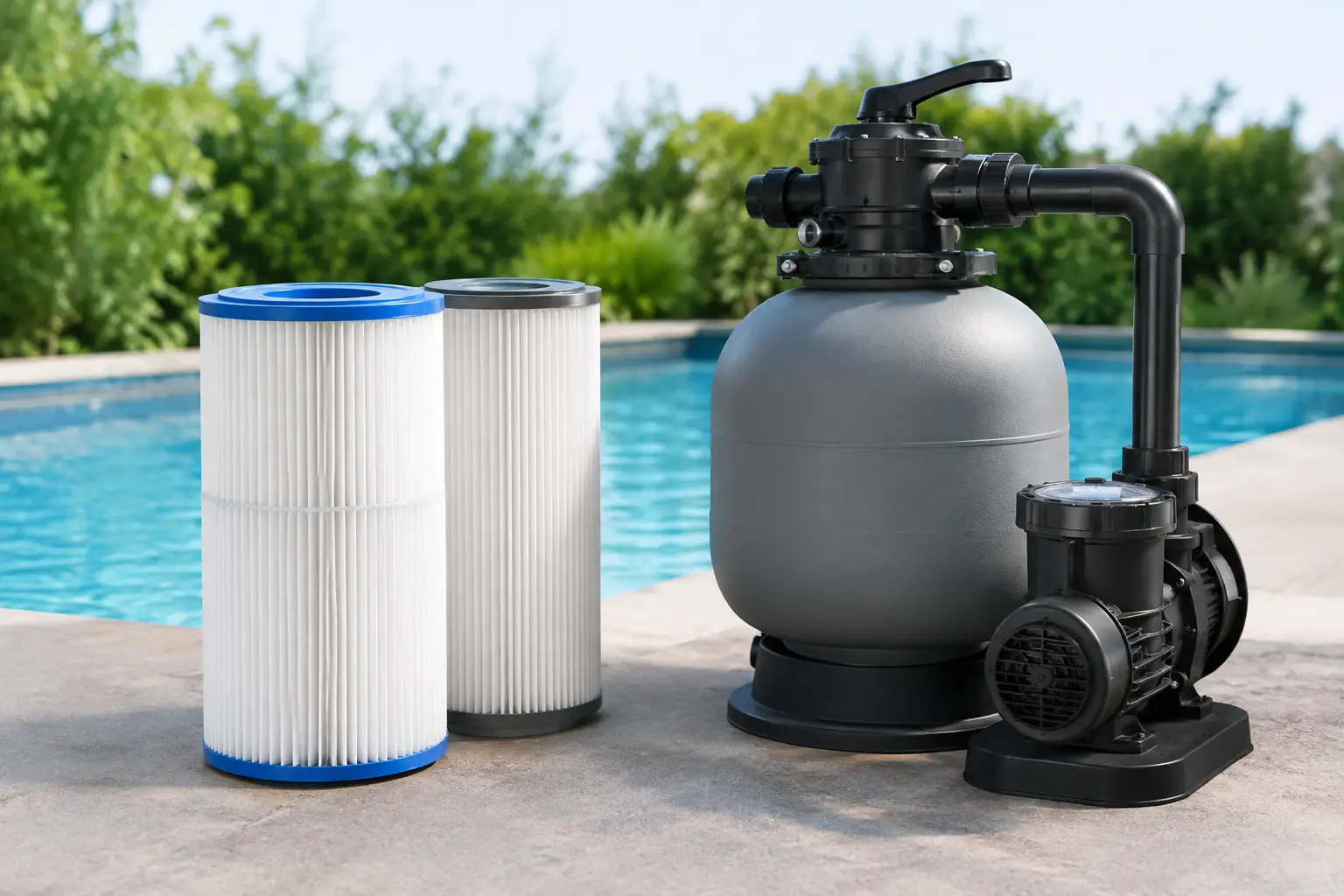
Cartridge Versus Sand Filters: Which Pool Filter Is Better?
By Jason DeBosky | 30-Year Pool Industry Veteran Published by The Pool Sharks
Meta Title: Cartridge Versus Sand Filters: Expert Comparison
Meta Description: Pool veteran Jason DeBosky compares cartridge versus sand filters, including activated glass media, filtration quality, maintenance, and water use.
Choosing the right pool filter affects water clarity, circulation, energy consumption, maintenance, and equipment life. When comparing cartridge versus sand filters, the best option is not necessarily the system with the lowest purchase price. It is the filter that matches the pool, equipment, surrounding environment, and homeowner’s expectations.
After 30 years in the pool industry, I have seen excellent and poorly performing examples of both filter types. A properly sized cartridge filter can provide fine filtration without wasting treated water. A correctly configured sand filter can offer durability, convenient backwashing, and exceptional performance when upgraded with premium activated glass media.
Both systems can produce clear water. However, their filtration capabilities, cleaning methods, water consumption, and ownership requirements are significantly different.
Cartridge Versus Sand Filters: Quick Comparison
| Consideration | Cartridge Filter | Sand Filter | |---|---|---| | Standard filtration range | Approximately 10–30 microns | Approximately 20–100 microns with standard sand | | Premium-media option | Not applicable | Activated glass may approach 1 micron | | Cleaning method | Remove and rinse cartridges | Backwash through a waste line | | Water consumption | No routine backwashing | Uses pool water during backwashing | | Maintenance style | Hands-on cartridge cleaning | Pressure monitoring and backwashing | | Replacement | Cartridges eventually wear out | Sand or glass media eventually requires replacement | | Heavy-debris handling | Effective but may need frequent cleaning | Convenient to backwash after major debris | | Best suited for | Fine filtration without a waste line | Durable operation and convenient backwashing |
These filtration ranges are general comparisons. Actual results depend on the manufacturer, filter size, media quality, pump speed, flow rate, plumbing, water chemistry, and maintenance.
How Cartridge Pool Filters Work
A cartridge filter contains one or more pleated fabric elements. Pool water passes through the pleats, which capture dirt, pollen, hair, insects, and suspended particles before the water returns to the pool.
Cleaning requires the system to be shut down and depressurized. The filter tank is opened, the cartridges are removed, and each element is rinsed carefully. Periodic deep cleaning may be necessary to remove oils, sunscreen, minerals, and contaminants that water alone cannot remove.
Advantages of Cartridge Filters
Cartridge filters generally capture smaller particles than conventional sand. When properly sized and maintained, they can provide polished water clarity and efficient circulation.
They do not require routine backwashing. This prevents the regular loss of chemically treated—and sometimes heated—pool water. It also makes cartridge filters useful on properties without an appropriate backwash discharge location.
Cartridge-filter advantages include:
- Good fine-particle filtration
- No routine backwashing
- Reduced water loss
- Large filtration surface area
- Compact equipment-pad options
- Efficient operation when properly sized
- No multiport valve required on many systems
Disadvantages of Cartridge Filters
Cartridges require physical removal and careful cleaning. Large cartridge assemblies can be time-consuming to service, particularly when oils, pollen, or heavy debris become embedded within the pleats.
When cartridges become overloaded, circulation decreases and the pool pump works harder than necessary. This can reduce skimming performance, affect heaters and sanitizing systems, and increase operating pressure.
Cartridge elements also have a limited lifespan. Improper pressure washing, damaged pleats, harsh chemicals, oils, poor water balance, and neglected cleaning can cause premature failure.
A cartridge filter performs well when it is adequately sized and serviced consistently. It is less forgiving when routine maintenance is ignored.
How Sand Pool Filters Work
A sand filter directs pool water through a tank containing specially graded filtration media. With a traditional system, that media is silica sand. Suspended debris becomes trapped as water moves through the filter bed.
When the filter pressure rises above its clean starting pressure, the filter is backwashed. Water flow reverses, lifts the media bed, and carries trapped debris through a waste line.
Following backwashing, the valve is normally placed in the rinse position briefly before returning to filtration.
Always shut the pump off before changing the position of a multiport valve. Moving the valve while water is flowing can damage the valve assembly.
Advantages of Sand Filters
Sand filters are durable, familiar, and relatively straightforward to operate. Backwashing allows the system to be cleaned without opening the tank or removing internal elements.
This can be beneficial following:
- Heavy storms
- Significant leaf accumulation
- Large gatherings
- Algae treatment
- Extended periods of vacancy
- Major environmental debris
Sand filters are often useful for pools surrounded by mature trees and for a seasonal residence where debris may accumulate between service visits.
Disadvantages of Standard Sand
Traditional silica sand generally captures larger particles than cartridge filtration. Very small particles may continue circulating even when the filter is operating correctly.
Backwashing also removes treated water. The replacement water must be added, tested, heated when necessary, and chemically balanced.
Standard sand may develop channeling, where water repeatedly follows the same pathways instead of moving evenly through the entire filter bed. Oils, minerals, debris, and biological material can also accumulate inside neglected sand.
Conventional sand is durable and economical, but it does not offer the finest available filtration.
Activated Glass Changes the Cartridge Versus Sand Comparison
A sand-filter tank does not have to contain conventional silica sand. It can often be filled with premium activated glass filter media when the filter manufacturer and system configuration permit it.
Activated glass is not simply broken or recycled glass. Premium products are engineered and treated to improve filtration, hydraulic performance, backwashing efficiency, and resistance to biological fouling.
Depending on the product, media grade, filter design, installation, and operating flow rate, activated glass media may filter particles down to approximately one micron.
Typical cartridge filters capture particles in the 10-to-30-micron range. Standard sand commonly filters within a broader 20-to-100-micron range. Therefore, a properly designed sand-style filter containing premium activated glass media may capture smaller particles than both conventional sand and many cartridge filters.
Benefits of Activated Glass Media
Premium activated glass may provide:
- Exceptional fine-particle filtration
- Improved water clarity
- Reduced channeling
- Resistance to biological fouling
- More effective backwashing
- Longer media life
- Reduced chemical demand
- Reduced water consumption through efficient cleaning
- Improved removal of oils and organic contaminants, depending on the product
This allows homeowners to retain the durability and convenient backwashing of a media-filter tank while achieving filtration that may surpass a cartridge system.
Not Every Glass Product Performs the Same
Ordinary crushed or recycled glass should not automatically be considered equivalent to engineered activated glass media.
Performance depends on:
- Product specifications
- Correct media grades
- Proper installation depth
- Filter compatibility
- Pump capacity
- Filtration flow rate
- Backwashing flow rate
- Plumbing configuration
- Correct media quantity
Poor-quality glass or an incorrect installation may not provide the expected improvement. Premium activated glass should be selected and installed according to manufacturer requirements.
Which Filter Produces Clearer Pool Water?
When comparing standard cartridge versus sand filters, cartridge filtration generally removes finer particles.
However, when a compatible sand-style filter is equipped with premium activated glass media, it may outperform many cartridge filters in fine-particle removal.
Filter type alone does not guarantee clear water. Water clarity also depends on:
- Pump speed and operating time
- Filter size
- Plumbing configuration
- Sanitizer level
- pH and alkalinity
- Calcium hardness
- Stabilizer
- Brushing and cleaning
- Swimmer demand
- Environmental debris
- Overall circulation
A premium filter cannot compensate for unbalanced chemistry or poor circulation. Likewise, a properly maintained standard filter can produce attractive water when the entire pool system is managed correctly.
Filter Size Matters as Much as Filter Type
One of the most common equipment mistakes is installing a filter that is too small for the pool.
An undersized filter loads with debris quickly, requires frequent cleaning, restricts circulation, and may place unnecessary strain on the pump.
A properly sized filter provides:
- More stable circulation
- Lower operating pressure
- Longer cleaning intervals
- Improved energy efficiency
- Better equipment performance
- More consistent water clarity
Pool volume is only one consideration. Pump capacity, plumbing size, spas, heaters, cleaners, automation, water features, swimmer use, and surrounding landscaping must also be evaluated.
Which Pool Filter Should You Choose?
Choose a cartridge filter when:
- There is no suitable backwash discharge location
- Avoiding routine water loss is important
- Good fine-particle filtration is desired
- Equipment-pad space is limited
- Regular cartridge cleaning will be maintained
Choose a standard sand filter when:
- Durability and straightforward operation are priorities
- The pool experiences heavy environmental debris
- Convenient backwashing is desired
- Appropriate drainage is available
- Initial equipment cost is an important consideration
Choose a sand-style filter with activated glass when:
- Exceptional fine-particle filtration is desired
- The homeowner prefers backwashing over cartridge removal
- The filter, pump, and plumbing are compatible
- Premium activated media will be professionally installed
- Long-term filtration performance is a priority
For many luxury residential pools, premium activated glass deserves serious consideration. It can combine fine filtration with the durability, capacity, and convenient cleaning process of a media filter.
Professional Care Protects Either Filter
A filter is only one part of a professionally managed pool. Pump performance, water level, skimmer operation, heater condition, sanitizer levels, automation, and seasonal weather all influence water quality.
When one component is ignored, the effects may appear as:
- Cloudy water
- Weak circulation
- Algae growth
- Increased energy consumption
- Pump strain
- Surface staining
- Preventable equipment repairs
At The Pool Sharks, we evaluate the complete operating environment rather than treating the filter as an isolated component.
Homeowners who prefer not to monitor pressure, clean cartridges, manage backwashing, or evaluate filter media can benefit from ongoing professional pool care.
Frequently Asked Questions
Are cartridge filters better than sand filters?
Cartridge filters generally capture finer particles than standard sand and do not require backwashing. However, premium activated glass installed in a compatible sand-style filter may provide finer filtration than many cartridge systems.
Is activated glass the same as ordinary filter glass?
No. Ordinary crushed or recycled glass may not provide the filtration performance or resistance to biological fouling associated with engineered activated glass media.
Which pool filter uses the least water?
Cartridge filters do not require routine backwashing. Sand and activated-glass systems use water during backwashing, although efficient activated media may require less frequent or more effective cleaning.
Can glass media be installed in every sand filter?
Not automatically. Filter compatibility, media grades, media quantity, pump capacity, and required backwashing flow must be verified before installation.
Will replacing the filter fix cloudy water?
Not necessarily. Cloudiness can result from chemistry, circulation, algae, environmental debris, equipment problems, or an undersized filter. The complete pool system should be evaluated.
Final Cartridge Versus Sand Filter Recommendation
The best choice in the cartridge versus sand filters debate depends on the pool, property, equipment, and homeowner’s expectations.
Cartridge filters provide good fine-particle filtration without routine backwashing. Standard sand filters offer durability and convenient cleaning. Sand-style filters containing premium activated glass may deliver the strongest combination of fine filtration, long media life, and operational convenience.
The Pool Sharks helps Northern Virginia homeowners evaluate, maintain, repair, and upgrade complete pool-equipment systems.
Request Private Client Access to discuss your pool’s filtration, circulation, and long-term equipment needs.
The Pool Sharks — Where Luxury Meets Peace of Mind.