
The History and Evolution of Swimming Pool Plaster
From ancient Roman mortars to modern glass aggregate finishes, discover the science and history behind your swimming pool's surface.
Introduction
Swimming pool plaster has changed dramatically over the centuries.
What began as lime-based waterproof mortar used to line ancient baths, cisterns, fountains, and water reservoirs eventually developed into the white Portland-cement and marble-plaster surfaces familiar to generations of American pool owners.
Today, homeowners can select from traditional white plaster, colored plaster, quartz aggregate, polished marble, natural pebble, glass bead, and other advanced cementitious finishes. Modern products may incorporate mineral pigments, graded aggregates, pozzolanic materials, polymers, proprietary fortifiers, and specialty additives designed to improve appearance, workability, strength, and resistance to the pool environment.
Although the materials have evolved, every cement-based pool finish still depends on several fundamentals:
- Proper surface preparation
- Accurate mixture proportions
- Consistent mixing
- Skilled application
- Correct troweling or aggregate exposure
- Immediate and uninterrupted filling
- Proper startup water chemistry
- Frequent brushing
- Long-term chemical balance
- Appropriate circulation and filtration
At The Pool Sharks, we believe understanding the history and science of pool plaster helps homeowners make better decisions about construction, renovation, maintenance, discoloration, and surface restoration.
We serve pool owners throughout Loudoun County, Fairfax County, and Fauquier County, including Ashburn, Leesburg, Purcellville, Aldie, Middleburg, Great Falls, McLean, Vienna, Chantilly, Centreville, Clifton, Warrenton, Marshall, Bealeton, and surrounding Northern Virginia communities.
Learn more about our Pool Plaster and Surface Care Services.
Ancient History of Pool Plaster
There is no reliable historical record identifying one specific pool as the first pool ever plastered.
Humans were building water-holding structures thousands of years before the invention of Portland cement. Ancient civilizations needed materials capable of lining reservoirs, baths, fountains, aqueducts, pools, and cisterns without allowing water to escape rapidly through masonry.
Early builders used combinations of:
- Burned lime
- Sand
- Crushed stone
- Crushed brick
- Crushed pottery
- Volcanic ash
- Ceramic fragments
- Natural mineral additives
These early materials were not modern swimming pool plaster, but they served a similar purpose. They created a smoother, more water-resistant lining over stone or masonry structures.
Roman Lime Mortars and Pozzolans
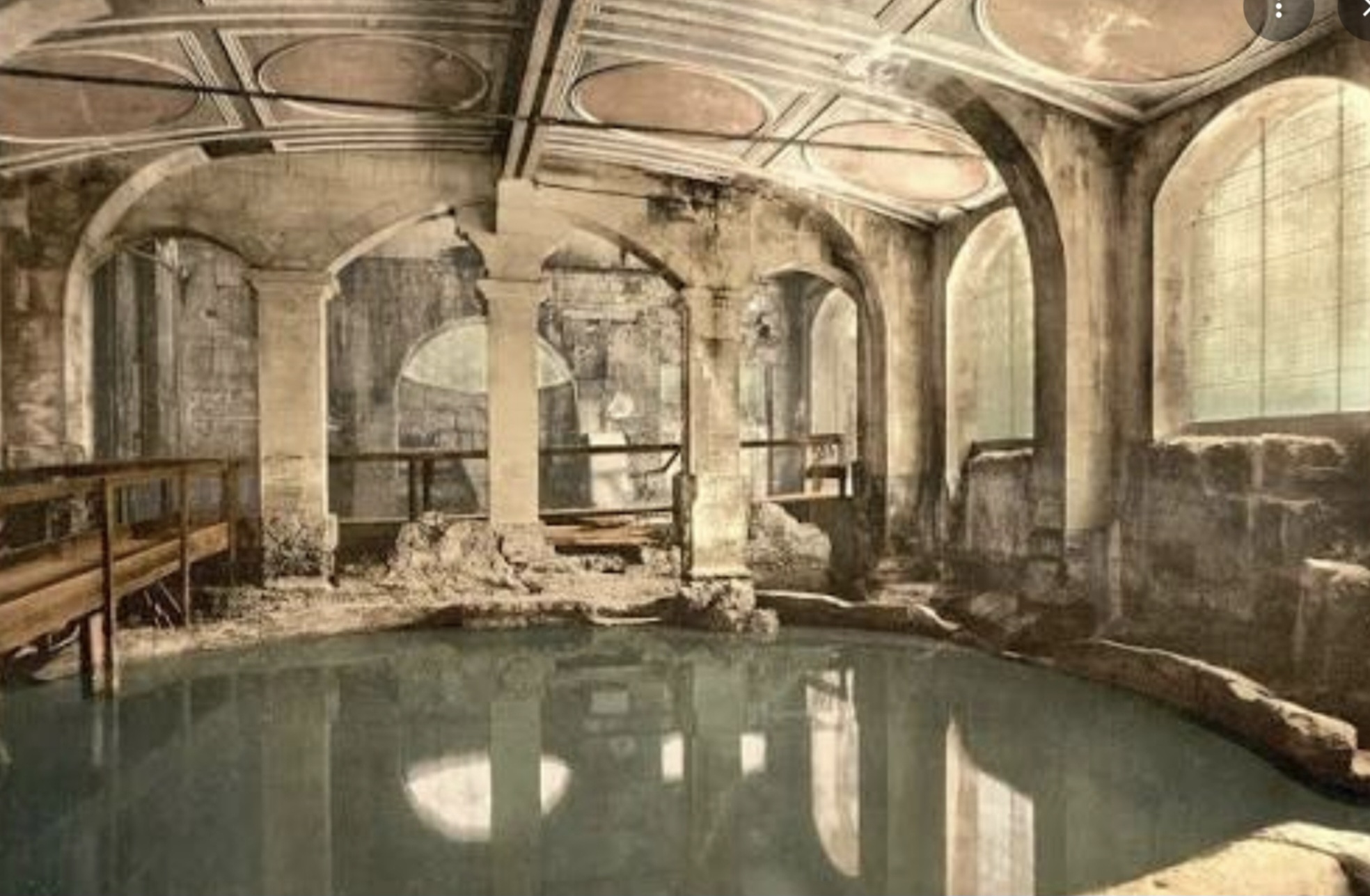
Ordinary lime mortar hardens through a reaction with carbon dioxide in the air. That process can be slow and is less effective when the material remains continuously wet.
Ancient builders eventually discovered that certain finely divided mineral and ceramic materials could react with lime and help the mortar harden in damp or submerged environments. These materials produced what is now described as a hydraulic mortar.
One important ancient water-resistant material is commonly known as opus signinum, generally produced from lime mortar combined with finely crushed pottery, tiles, or brick.
Roman builders also made extensive use of volcanic ash found near locations such as Pozzuoli, Italy. The word pozzolan originates from this association.
When an appropriate pozzolan is combined with lime and water, reactive silica and alumina can form additional cementitious compounds. These reactions can create a material that is denser, more durable, and more capable of hardening in wet environments than lime alone.
The Development of Portland Cement
For centuries, lime remained one of the primary binders used in masonry and plaster. The development of Portland cement during the nineteenth century changed construction significantly.
Portland cement hardens through hydration. When water is added, the cement compounds react and form hardened binding products that hold aggregates together. Unlike traditional nonhydraulic lime, Portland cement can develop significant strength without depending exclusively on exposure to carbon dioxide in the air.
This made it well suited for concrete, mortar, structural construction, water-retaining structures, and swimming pool shells.
White Portland cement later allowed installers to produce light-colored finishes without the dark gray appearance associated with conventional gray cement.
Traditional White Marble Pool Plaster
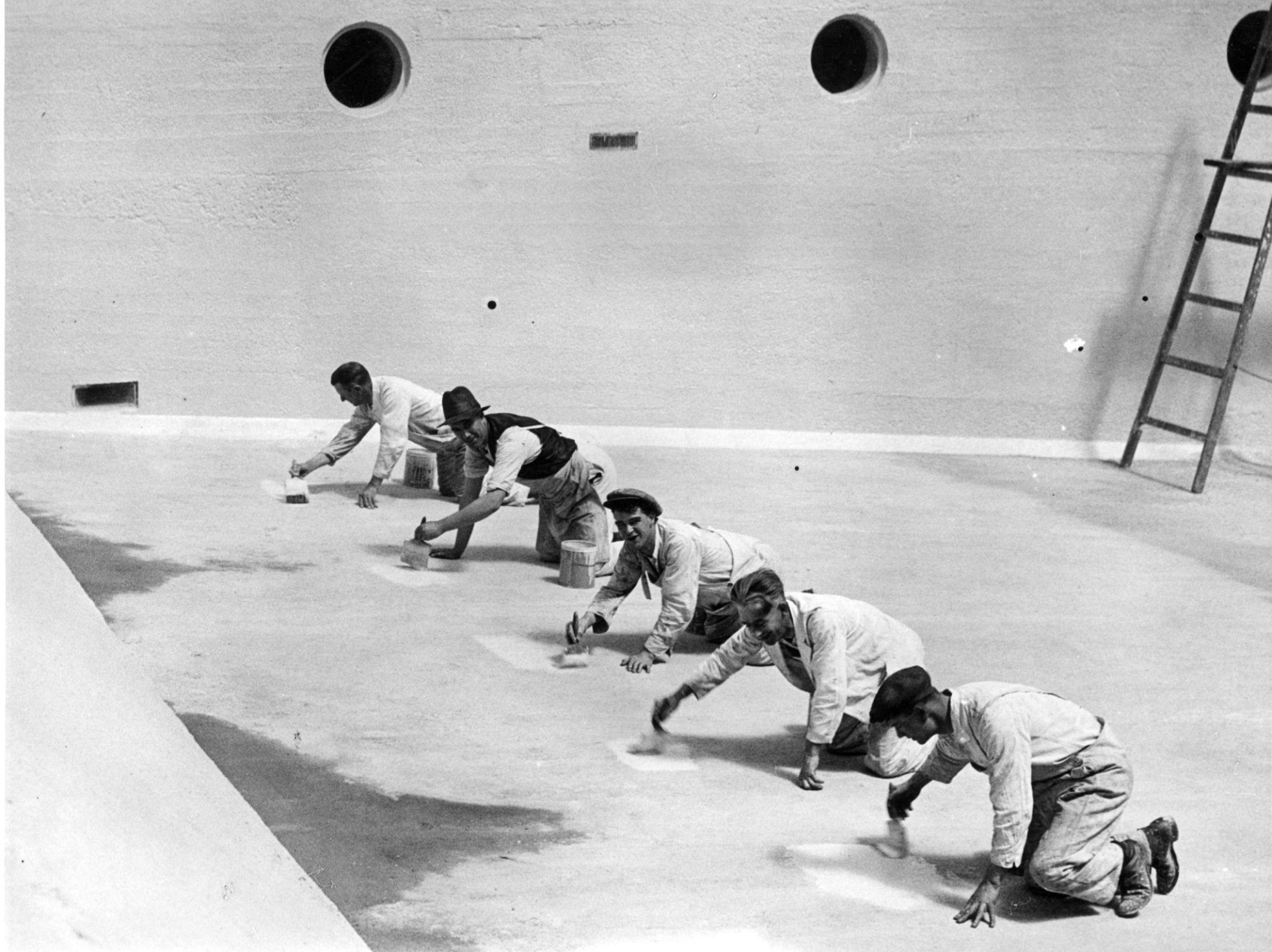
Traditional swimming pool plaster is generally based on white Portland cement combined with a white mineral aggregate.
White cement is manufactured to contain lower levels of coloring compounds than ordinary gray cement. This gives the finished plaster a clean white appearance and provides a neutral base for mineral pigments. The white surface also changes the perceived color of the water.
For many years, the standard American pool finish consisted primarily of white Portland cement, finely graded marble aggregate, water, and approved admixtures when necessary.
Marble became a popular pool-plaster aggregate because it is naturally light in color, compatible with white cement, and capable of producing a smooth surface. However, marble is primarily calcium carbonate. It is vulnerable to aggressive water that is chemically capable of dissolving calcium from the surface.
Improperly maintained water can contribute to etching, roughness, pitting, calcium loss, discoloration, and shortened finish life.
Colored Pool Plaster
As homeowners sought more customized swimming pools, manufacturers and installers began adding pigments to traditional plaster mixtures. Pigments allowed finishes to be produced in colors such as light blue, medium blue, gray, charcoal, black, green, tan, and beige.
The pigment is normally mixed into the cementitious material before installation. Colored plaster is therefore not simply white plaster with paint applied to the surface. The color is incorporated into the installed plaster mixture.
However, colored cement-based finishes create new visual considerations. Small variations that may be difficult to see in white plaster can become noticeable in gray, blue, or black plaster. These variations may include mottling, pigment movement, trowel marks, hydration discoloration, plaster dust, calcium deposits, uneven curing, and surface streaking.
A handcrafted colored cement surface should not be expected to look exactly like a factory-painted panel.
Modern Pool Finishes
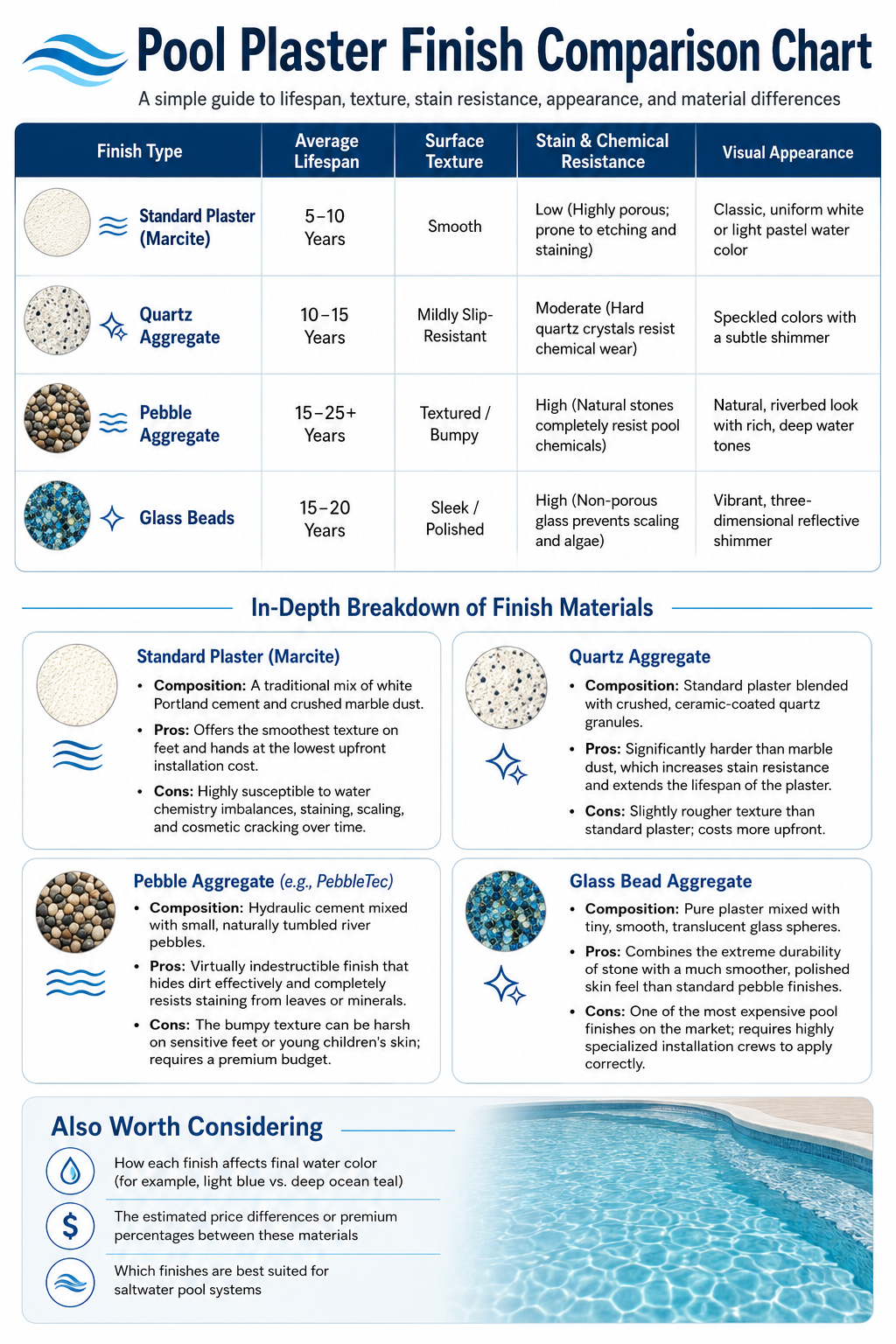
Quartz Finishes
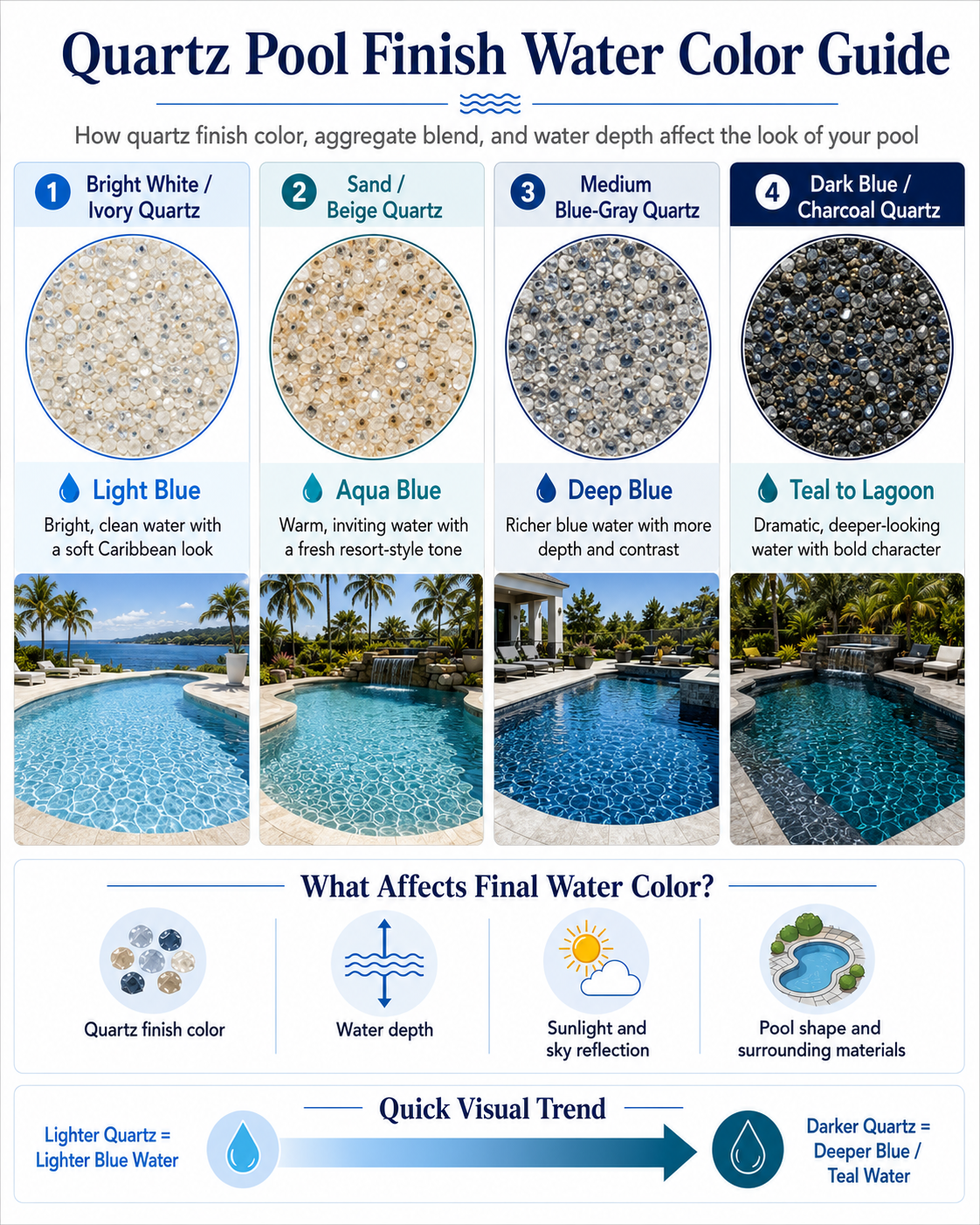
Quartz aggregate finishes represented a significant advancement beyond standard marble plaster. Quartz is harder and more chemically resistant than marble.
A quartz pool finish generally combines white Portland cement, crushed quartz aggregate, mineral pigment, specialty additives, and water.
Quartz finishes can provide greater wear resistance, improved durability, more color choices, and increased visual texture.
Pebble Finishes
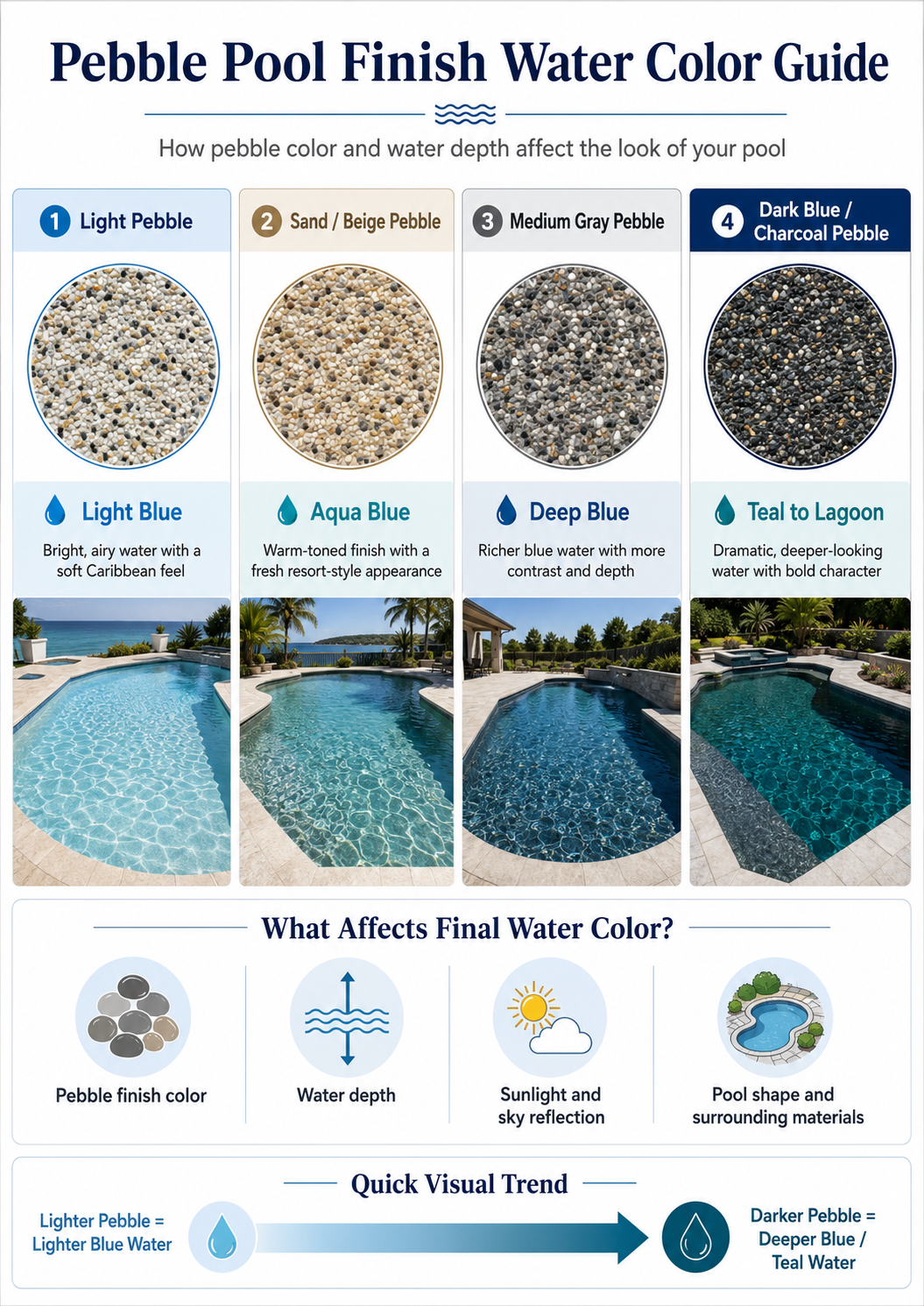
Pebble pool finishes became widely recognized as an alternative to traditional plaster during the 1980s. Instead of relying primarily on fine marble aggregate, pebble finishes incorporate larger natural stones.
After the material is applied, part of the cement paste is removed to expose the decorative aggregate.
Pebble finishes offered homeowners a more natural appearance, greater aggregate hardness, increased wear resistance, and longer expected service life.
Glass Finishes
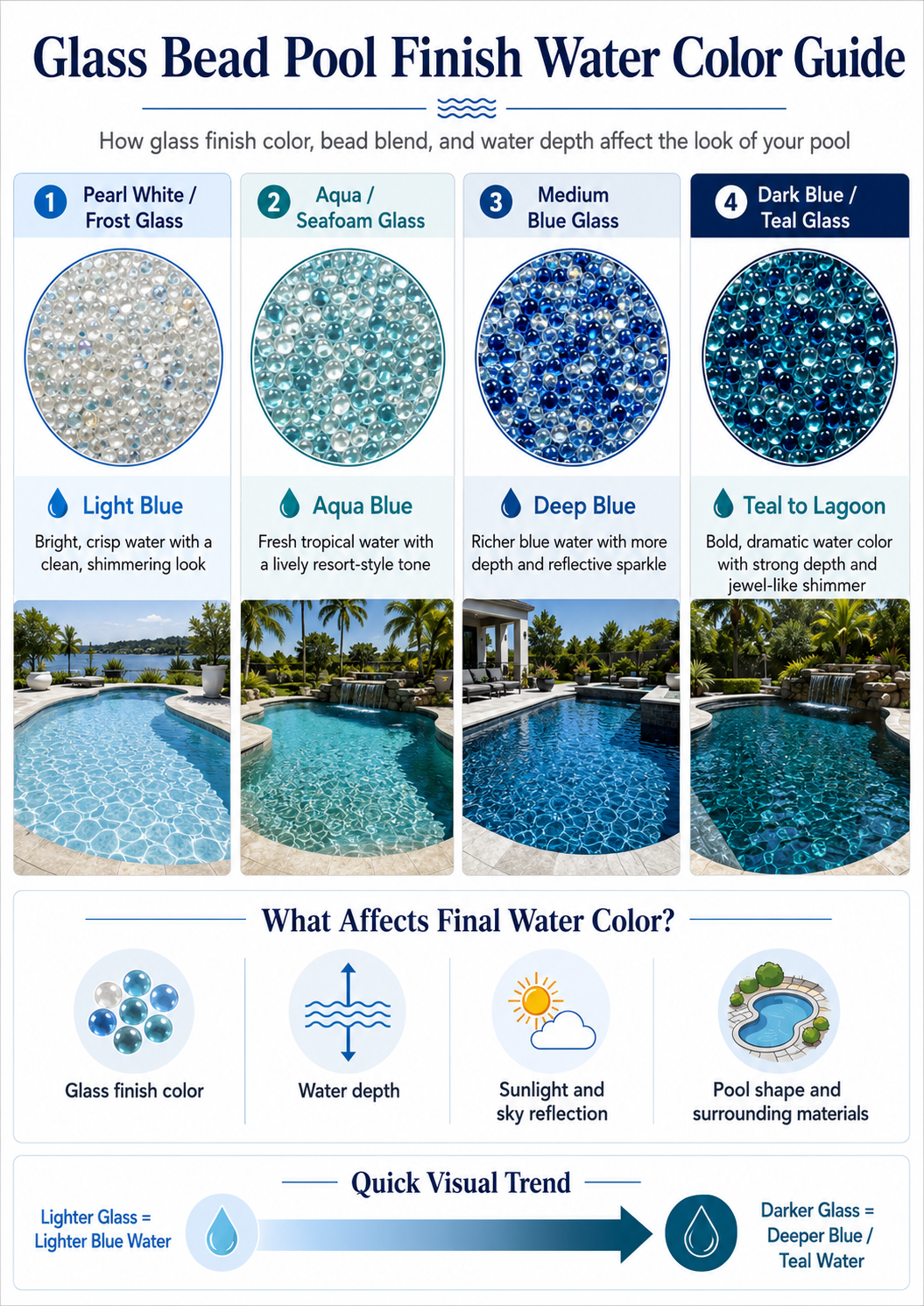
Glass bead finishes introduced another visual option. These finishes may contain transparent, translucent, reflective, or colored glass aggregates embedded in a cementitious matrix.
Glass can create sparkle, depth, reflectivity, jewel-like color, and strong visual changes under sunlight.
Glass aggregate is not the structural binder; performance depends on both the aggregate and the quality of the binder.
Modern Cement Technology
A pozzolan is a siliceous or siliceous-and-aluminous material that can react with calcium hydroxide in the presence of water to form additional cementitious compounds. Natural pozzolans may include volcanic ash, while manufactured materials may include metakaolin, silica fume, or calcined clay.
When properly selected and proportioned, pozzolanic materials may help consume some calcium hydroxide, reduce permeability, increase density, improve chemical resistance, and strengthen the cementitious matrix.
Modern finish systems may also use polymers, liquid admixtures, or proprietary cement fortifiers. Depending on the product, these ingredients may improve workability, adhesion, flexural performance, density, water resistance, and aggregate retention.
However, pozzolans and polymers do not make plaster indestructible. The finish can still be damaged by improper substrate preparation, excessive mix water, poor application, inadequate curing, aggressive acid treatment, or improper startup.
How Plaster Works & Is Installed
The new finish must bond to a structurally sound substrate. The pool shell or prepared surface should be free of loose plaster, dust, dirt, oils, paint, algae, or bond-inhibiting residue. A beautiful aggregate blend cannot compensate for a weak bond beneath it.
Pigmented and aggregate finishes must be mixed consistently from batch to batch. Variations in cement quantity, aggregate quantity, pigment quantity, water quantity, or mixing time can change appearance.
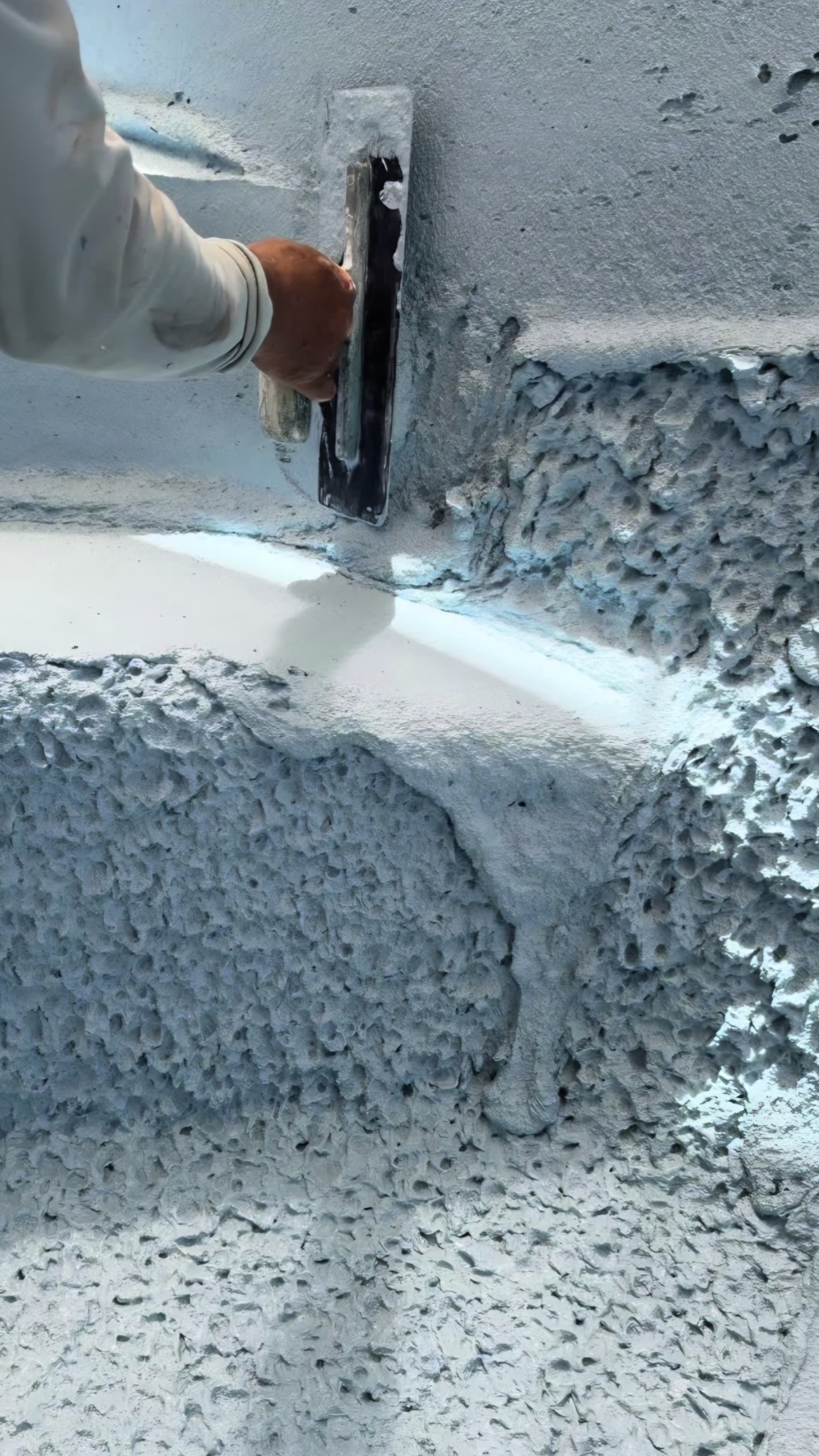
Troweling compacts and smooths the finish. The timing, pressure, and number of trowel passes influence the surface. In colored finishes, inconsistent troweling can contribute to dark areas, light areas, trowel burns, pigment variation, and mottling.
Although products vary, a cementitious pool finish generally follows a sequence that includes:
- Draining the pool and removing or preparing the existing surface
- Repairing hollow, loose, or damaged areas
- Preparing the substrate for bonding and wetting it appropriately
- Mixing the finish consistently
- Pumping or transporting the material
- Applying the finish to the pool shell
- Troweling the material
- Exposing, washing, polishing, or otherwise completing the selected surface
- Beginning the fill immediately and filling continuously
- Starting the required chemical and brushing program
Why Proper Startup Is Critical
The initial curing and startup period has an enormous influence on the appearance of a cement-based pool finish.
After the finish has been completed, filling should normally begin as directed by the installer and continue without interruption until the water reaches the required level. Stopping the water can leave a visible fill line. The exposed upper portion of the plaster continues curing and drying differently from the submerged portion. That difference may become permanent.
The startup process should not be treated as routine weekly maintenance. A professional startup may require frequent water testing, controlled chemical adjustments, daily brushing, continuous circulation, and delayed salt or heater use.
The first several weeks can influence the finish for years.

National Plasterers Council (NPC)
The National Plasterers Council provides education and technical guidance for pool plaster applicators, builders, and service professionals. Its technical resources address the entire life of a cementitious pool finish.
The NPC strongly recommends that newly plastered swimming pools receive a structured startup procedure designed to protect the appearance and service life of the new finish while the cementitious material continues to hydrate and cure.
Plaster Dust
New plaster can release fine particles and calcium-rich material commonly described as plaster dust. If this material is not removed, filtered, and controlled through proper chemistry, it may settle or harden on the surface.
The result can appear as a white haze, gray film, light streaks, chalky deposits, or cloudy areas. Frequent brushing helps remove loose material before it bonds firmly to the finish.
Calcium Scale
A colored plaster, quartz, pebble, or glass finish may contain attractive pigment and aggregate beneath a thin calcium-rich surface layer. The deposit changes the way light reflects from the finish.
This can make the pool appear lighter than selected, gray, chalky, cloudy, streaked, or uneven. Controlled removal may reveal more of the original color underneath.
Mottling and Discoloration
Cement hydration is not perfectly uniform across every inch of a hand-applied pool surface. The final appearance can be influenced by water-to-cement ratio, mixing time, pigment dispersion, batch consistency, temperature, sun exposure, wind, substrate absorption, troweling, and startup chemistry.
Dark finishes show these differences more clearly because changes in cement density and surface deposits affect light reflection. Some mottling is characteristic of colored cementitious materials.
Striations (visible lines, streaks, or bands across the finish) can be caused by plaster dust settling unevenly, calcium depositing on the surface, inconsistent brushing, or surface water movement.
Water Chemistry
Water is constantly interacting with the pool surface. When water is overly aggressive, it may dissolve calcium-bearing material from the finish. This can cause etching, roughness, fading, exposed aggregate, pitting, and shortened service life.
When water is excessively scale-forming, calcium may deposit on the surface. This can cause white film, roughness, discoloration, scale lines, and hidden aggregate color.
Long-term finish care requires balancing pH, total alkalinity, calcium hardness, water temperature, cyanuric acid, total dissolved solids, sanitizer, and metals.
Frequently Asked Questions
Contact The Pool Sharks
Whether your pool has traditional white plaster, colored plaster, quartz, pebble, glass, or polished aggregate, the finish should be evaluated as an integrated system.