
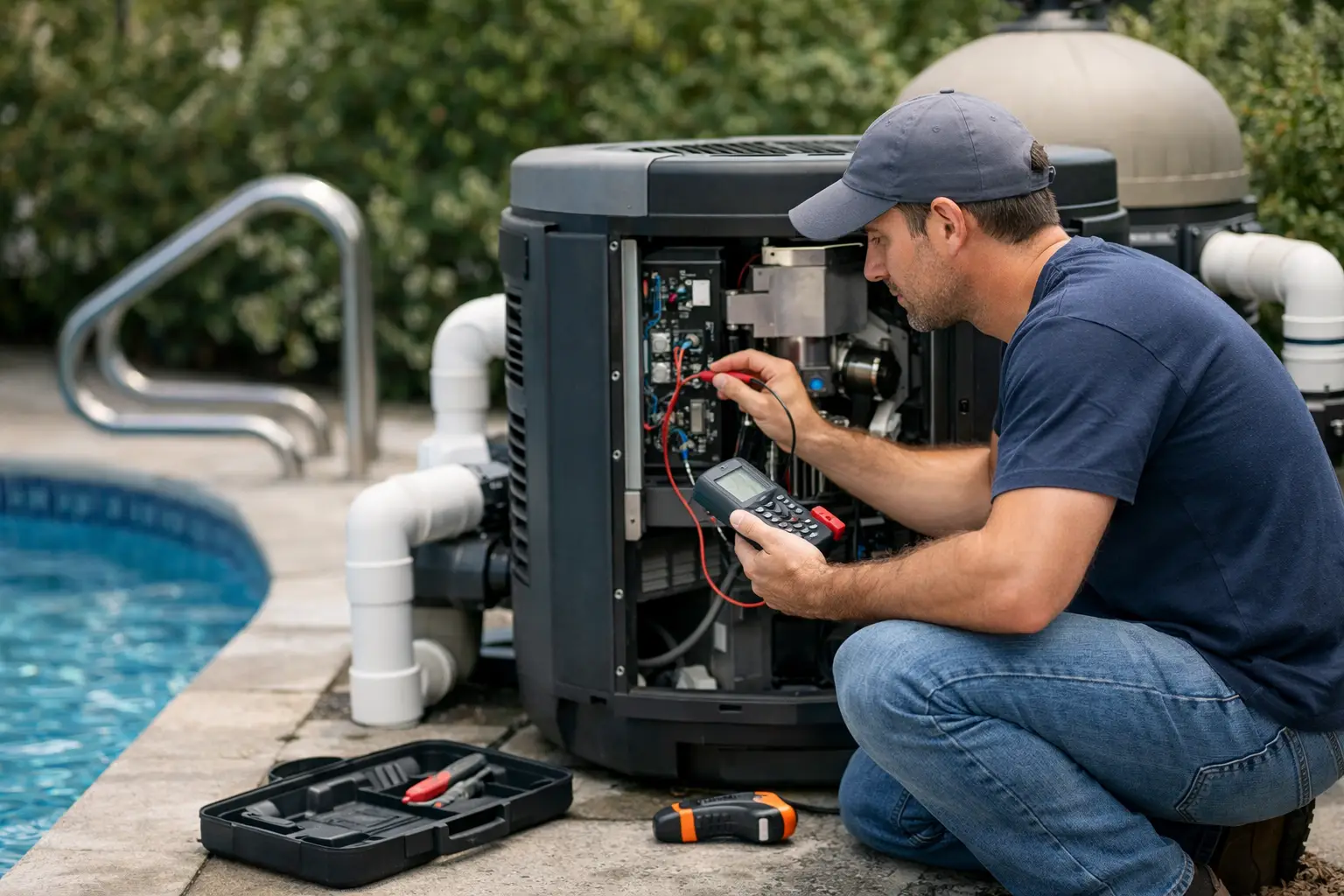
How to Diagnose Pool Heater Problems in Northern Virginia
By Jason DeBosky | 30-Year Pool Industry Veteran Published by The Pool Sharks
A swimming pool that is perfectly clear but stubbornly cold can make an otherwise beautiful backyard feel like an unfinished amenity. For homeowners throughout Northern Virginia, knowing how to diagnose pool heater problems starts with one important distinction: determine whether the heater is receiving the water flow, power, fuel, and control signal it needs before assuming the heater itself has failed.
This systematic approach can prevent unnecessary repairs, protect expensive pool equipment, and give a professional technician a much clearer starting point if service is ultimately required.
For most homeowners, visual inspections, basic circulation checks, and reviewing the heater display are appropriate. Work involving gas lines, high-voltage electrical components, refrigerant, internal combustion components, or sealed heater systems should be left to a qualified pool professional.
Start With the Pool Heater Symptom
Before changing settings, resetting breakers, or assuming the heater has failed, determine exactly what the system is doing.
Ask a few basic questions:
- Is the circulation pump running?
- Is the heater display powered on?
- Is an error or service code displayed?
- Does the heater attempt to start?
- Does it ignite and then shut down?
- Is the heater running but failing to warm the water?
- Did the problem occur suddenly or develop gradually?
A gas pool heater that will not ignite requires a different diagnostic path than a heat pump that runs continuously without significantly increasing water temperature.
Northern Virginia weather should also be considered. Cool fall evenings, sudden temperature drops, wind, and leaving a pool uncovered overnight can dramatically increase heat loss. A heater may therefore be operating correctly while appearing to struggle to maintain temperature.
A properly fitted pool cover can significantly reduce overnight heat loss. A spa should also heat considerably faster than a swimming pool because of its much smaller water volume.
If your heater is repeatedly cycling on and off, producing unusual noises, creating a burning odor, displaying persistent service warnings, or showing other abnormal behavior, shut the heater down and arrange for professional evaluation.
Repeatedly resetting a malfunctioning heater can mask the underlying problem and potentially place additional stress on expensive components.
How to Diagnose Pool Heater Flow Problems
Adequate water circulation is one of the first requirements for virtually every swimming pool heater.
Most modern heaters will prevent ignition or heating when the system cannot move enough water through the heat exchanger. Fortunately, circulation is also one of the easiest areas for a homeowner to inspect safely.
Start by confirming that the circulation pump is operating during the period when the heater is expected to run.
If your pool uses a variable-speed pool pump, verify that the pump is operating at an appropriate heating speed rather than a very low filtration RPM.
Many swimming pools require a higher pump speed to produce enough flow to activate the heater's pressure or flow safety system.
Next, inspect:
- Skimmer baskets
- Pump basket
- Filter pressure
- Return-jet strength
- Equipment valves
- Visible air inside the pump
- Pool and spa valve positions
A dirty filter, clogged basket, improperly positioned valve, suction restriction, or low pump speed can reduce circulation enough to prevent the heater from operating.
Check the Pool Filter Pressure
Know your pool's normal filter pressure when the filter is clean.
If pressure has increased noticeably above that baseline, the filter may require cleaning or service.
Conversely, unusually low pressure combined with weak return flow or significant air inside the pump basket may indicate a suction-side restriction, low water level, clogged basket, or air leak.
The important point is that a pool circulation problem can easily appear to be a heater problem.
Check Pool and Spa Valves
Verify that valves associated with the heater and circulation system are positioned correctly.
This is especially important after:
- Pool opening
- Pool closing
- Equipment repairs
- Filter service
- Automation changes
- Switching between pool and spa modes
Do not force a valve that is difficult to operate. A damaged valve, actuator, or internal diverter can restrict circulation and create symptoms that resemble heater failure.
After correcting a circulation problem, allow the system several minutes to establish normal flow. The heater may require additional time to recognize adequate circulation and complete its startup sequence.
Check Pool Heater Settings and Automation
A heater cannot respond to a heating command it never receives.
Confirm that the requested temperature is higher than the current water temperature and that the heater is assigned to the correct body of water.
On pools equipped with pool automation systems, heating may be controlled through a central automation panel, mobile application, or remote interface rather than directly from the heater.
This is increasingly common throughout McLean, Great Falls, Vienna, Ashburn, Leesburg, Reston, Oakton, Fairfax, Gainesville, Haymarket, Warrenton, and surrounding Northern Virginia communities, where pools frequently incorporate automation, variable-speed pumps, spas, salt systems, and multiple water features.
Verify the Water Temperature Reading
Compare the temperature displayed by the automation system or heater with a reliable pool thermometer.
A minor difference is normal.
A significant difference may indicate a temperature-sensor problem. If the automation system incorrectly believes the water has already reached the requested temperature, it may never send a call for heat.
Also review the equipment schedule.
Heating can sometimes be affected by:
- Pump schedules
- Low-speed filtration programs
- Freeze protection
- Energy-saving settings
- Service mode
- Standby mode
- Pool/spa configuration
- Automation programming
If pool equipment was recently replaced or automation settings were changed, verify that the heater, pump, valves, sensors, and automation system are communicating correctly.
Check Pool Heater Power Safely
For electric heat pumps and electric pool heaters, begin with exterior observations.
Is the display powered?
Has a breaker tripped?
Is the equipment disconnect in the proper position?
A breaker that trips repeatedly should not simply be reset over and over.
Repeated breaker trips can indicate problems involving wiring, motors, compressors, electrical components, moisture intrusion, or internal heater components.
Gas pool heaters also require electrical power. Modern gas heaters use electricity for control boards, ignition systems, displays, sensors, blowers, and safety circuits.
If the heater display is completely blank, check the equipment subpanel and appropriate GFCI protection where applicable.
Do not remove electrical panels or test energized components unless you are properly qualified.
Standing water around electrical equipment, deteriorated wiring, damaged conduit, or visible corrosion should also receive prompt professional attention.
Diagnosing a Gas Pool Heater That Will Not Ignite
If a gas pool heater has electrical power and adequate water flow but does not ignite, verify that the external gas supply valve is open and that there is no known interruption in gas service to the property.
If other gas appliances in the home are also not operating, the problem may exist upstream from the swimming pool equipment.
Modern electronic-ignition pool heaters should not be manually lit unless the manufacturer specifically provides a homeowner procedure for that model.
If you smell gas, hear hissing, observe soot, or suspect a gas leak, shut the heater down, move away from the immediate equipment area, and contact the appropriate gas utility or qualified professional.
Never continue operating a gas pool heater with:
- Visible soot
- Combustion abnormalities
- Damaged venting
- Blocked air intake
- Severe corrosion
- Persistent ignition problems
- Gas odors
Pool Heater Error Codes
Error codes provide valuable diagnostic information, but an error code is not necessarily the final diagnosis.
Codes involving ignition, pressure, high-limit conditions, airflow, temperature sensors, or water flow can have several possible causes.
For example, similar symptoms may result from:
- Restricted water circulation
- Dirty filtration
- Incorrect pump speed
- Inadequate gas pressure
- Failed temperature sensors
- Pressure-switch problems
- Blower problems
- Ignition-system faults
- Control-board failures
Before calling for service, photograph or write down the exact error code and heater model number.
That information can significantly improve the diagnostic process.
How to Diagnose Pool Heat Pump Problems
Pool heat pumps operate differently from traditional gas heaters.
Instead of producing heat through combustion, a heat pump extracts available heat from the outdoor air and transfers it into the pool water.
Because of this, heat-pump performance changes with outdoor temperature and humidity.
During cooler Northern Virginia spring and fall conditions, a heat pump may operate for extended periods while producing a relatively gradual increase in pool temperature.
That does not automatically mean the heat pump has failed.
Check Airflow Around the Heat Pump
Heat pumps require unrestricted airflow.
Keep the surrounding area free from:
- Leaves
- Mulch
- Furniture
- Pool accessories
- Overgrown landscaping
- Other airflow obstructions
Light frost can occur under certain operating conditions, and many heat pumps periodically enter a defrost cycle.
However, heavy ice accumulation, persistent fan problems, grinding noises, electrical faults, or a heat pump that runs continuously without warming the pool should be professionally evaluated.
Do not attempt refrigerant repairs or use aggressive chemicals to clean internal components.
Heat-pump performance depends on precise refrigeration pressures, electrical controls, airflow, temperature sensors, and other components that require proper diagnostic equipment.
When Pool Heater Troubleshooting Should Stop
There are several pool-heater problems homeowners can often identify or correct themselves.
These can include:
- Cleaning a clogged basket
- Cleaning or servicing a dirty filter
- Correcting an improperly positioned valve
- Increasing variable-speed pump RPM
- Correcting a pump schedule
- Selecting the proper pool or spa mode
- Adjusting the requested water temperature
Once those basic conditions have been verified, the objective should change from experimentation to safe, accurate diagnosis.
Schedule professional pool heater repair if your heater:
- Repeatedly displays error codes
- Trips electrical breakers
- Leaks water
- Smells of gas
- Fails to ignite
- Produces soot
- Makes abnormal mechanical noises
- Cycles repeatedly
- Runs without heating
- Cannot maintain temperature despite proper circulation
Heater inspection can also be incorporated into seasonal pool service, particularly for Northern Virginia homeowners with second homes, seasonal residences, or properties that remain vacant for extended periods.
Professional Pool Heater Repair in Northern Virginia
A pool heater should not be viewed as an isolated appliance.
Its performance depends on the entire swimming pool system.
The Pool Sharks evaluates heater concerns in conjunction with circulation, filtration, water chemistry, automation, valves, sensors, pump performance, and the overall equipment configuration.
For homeowners throughout Fairfax County, Loudoun County, Prince William County, and Fauquier County, properly maintaining these interconnected systems helps protect expensive equipment while keeping the pool ready when it is wanted.
A properly operating heater should largely disappear into the background of pool ownership.
You select the temperature.
The equipment responds.
And the pool is ready.
That is the standard a professionally maintained pool environment should deliver.
Related Articles
Serving Northern Virginia, including Fairfax County, Loudoun County, Prince William County, Fauquier County, McLean, Great Falls, Vienna, Reston, Oakton, Ashburn, Leesburg, Gainesville, Haymarket, Warrenton, and surrounding communities.