How to Prevent Pool Algae in Northern Virginia: A Proactive Guide to Clear, Polished Water
By Jason DeBosky | 30-Year Pool Industry Veteran Published by The Pool Sharks
A swimming pool can look immaculate on Friday and show the first signs of trouble by Monday. In Northern Virginia, summer heat, thunderstorms, heavy pollen, landscaping debris, and a weekend full of swimmers can change water conditions surprisingly quickly.
For homeowners in Loudoun County, Fairfax County, Prince William County, Fauquier County, and throughout Northern Virginia, knowing how to prevent pool algae is not about waiting for the water to turn green and then pouring chemicals into it.
The better approach is prevention.
Consistent water balance, dependable circulation, proper filtration, routine surface care, and professional oversight create conditions where algae has very little opportunity to establish itself.
For homeowners who expect their pool to remain a polished extension of their property, proactive care protects more than water clarity. It helps reduce unnecessary chemical treatments, protects expensive pool equipment and finishes, and keeps the pool ready for an afternoon swim, an evening gathering, or an unexpected weekend of entertaining.
Why Pool Algae Can Develop So Quickly in Northern Virginia
Algae consists of microscopic organisms that can multiply rapidly when pool conditions become favorable.
Warm water, inadequate sanitizer, poor circulation, organic debris, and neglected filtration can create the perfect environment.
Northern Virginia pools experience several seasonal conditions that can increase algae pressure:
- Intense summer heat and sunlight
- Heavy thunderstorms and rainfall
- Spring pollen
- Leaves and organic debris
- High swimmer loads
- Extended periods of humidity
- Landscaping debris around heavily wooded properties
- Pools left unattended while homeowners travel
Algae often begins subtly.
You may notice the water losing some of its usual sparkle. Steps may feel slightly slippery. A shaded corner may develop faint discoloration. Fine debris may repeatedly collect in the same location.
Those early signs matter.
By the time an entire pool appears green, the underlying conditions may have been developing for several days.
The most reliable defense is not one chemical or one treatment. It is a properly managed pool system where water chemistry, circulation, filtration, cleaning, and equipment performance work together.
How to Prevent Pool Algae With Proper Water Chemistry
Sanitizer is the pool's primary defense against algae.
Whether your pool uses traditional chlorine or a salt chlorine generator, sufficient active chlorine must remain available to sanitize the water continuously.
Chlorine demand can change dramatically depending on conditions.
A pool that tested perfectly before the weekend may experience significantly different chemistry after:
- A pool party
- Several extremely hot days
- Heavy rainfall
- Large amounts of pollen
- Landscaping work
- Leaves or debris entering the water
That is why professional pool maintenance should respond to the actual condition of the water, rather than simply adding the same amount of chemicals every week.
Maintain Proper pH
Maintaining proper pH is equally important.
For most residential swimming pools, maintaining pH around 7.2 to 7.8 provides a practical operating range for swimmer comfort, equipment protection, and effective sanitation.
When pH climbs excessively, chlorine becomes less effective at controlling microorganisms even when a chlorine test indicates sanitizer is present.
Other chemistry factors also matter, including:
- Total alkalinity
- Calcium hardness
- Cyanuric acid
- Free chlorine
- Combined chlorine
- Salt levels in saltwater pools
- Water temperature
- Overall water balance
These values interact with one another.
That is why simply adding more chlorine whenever the water looks questionable is not always the correct solution.
Professional water care considers the entire chemistry profile before making adjustments.
Cyanuric Acid Plays an Important Role in Outdoor Pools
Cyanuric acid, commonly called CYA or chlorine stabilizer, helps protect chlorine from rapid destruction by ultraviolet sunlight.
Think of cyanuric acid as a form of sun protection for chlorine.
Without sufficient stabilizer, sunlight can consume chlorine quickly during a hot Northern Virginia summer day.
However, excessive cyanuric acid can create another problem by requiring higher free-chlorine levels to maintain effective sanitation.
The objective is not simply to add stabilizer.
The objective is to maintain an appropriate relationship between cyanuric acid and available chlorine.
This is another reason complete water testing is important when developing an algae-prevention strategy.
Do Not Let Leaves, Pollen, and Debris Become Algae Fuel
Northern Virginia's beautiful landscaping creates one of the region's biggest pool-maintenance challenges.
Trees provide privacy and shade, but they also introduce:
- Pollen
- Leaves
- Seed pods
- Small branches
- Insects
- Organic dust
As organic material decomposes, it consumes sanitizer and increases the burden placed on the filtration system.
During heavy pollen season in communities such as Leesburg, Ashburn, Purcellville, Great Falls, McLean, Vienna, Gainesville, Haymarket, and Warrenton, a pool may require substantially more attention than it does later in the summer.
Skimmer baskets should be emptied regularly, pump baskets should remain clear, and visible debris should be removed before it settles onto the pool floor.
A professional maintenance schedule should respond to these changing conditions rather than relying solely on the calendar.
Proper Pool Circulation Helps Prevent Algae
Water that does not circulate effectively creates opportunities for algae.
Circulation distributes sanitizer throughout the swimming pool and carries suspended contaminants toward the filtration system.
Areas with inadequate circulation can develop around:
- Steps
- Benches
- Tanning ledges
- Ladders
- Swim-outs
- Corners
- Water features
- Deep-end transitions
Return fittings should be positioned to encourage movement throughout the entire pool rather than simply disturbing the surface near the returns.
Pump operation also matters.
The correct circulation schedule depends on several factors, including pool volume, plumbing design, equipment configuration, pump speed, temperature, swimmer load, and environmental conditions.
There is no universal pump-runtime setting that is ideal for every Northern Virginia swimming pool.
Weak Circulation May Be an Equipment Problem
If water movement suddenly changes, the problem may not be chemical at all.
Weak circulation can result from:
- Clogged skimmer baskets
- A clogged pump basket
- Dirty filtration
- Air entering the suction side
- Improper valve positions
- Pump problems
- Blocked plumbing
- Incorrectly positioned return fittings
- Automation programming issues
If debris repeatedly settles in the same areas or return pressure becomes noticeably weaker, the circulation system deserves closer inspection.
Preventive pool equipment service can identify developing mechanical issues before they begin affecting water quality.
Keep the Pool Filter Performing Properly
Your pool filter is responsible for removing fine contaminants that cannot simply be skimmed from the surface.
When filtration becomes restricted or ineffective, water clarity can deteriorate and algae pressure can increase.
Different filtration systems require different maintenance.
Cartridge Filters
Cartridge elements should be cleaned according to pressure readings, debris load, water conditions, and manufacturer recommendations.
DE Filters
DE filtration systems require proper cleaning procedures and the correct amount of replacement DE following service.
Sand Filters
Sand filters require appropriate backwashing and periodic evaluation of the filtration media and internal components.
More cleaning is not necessarily better.
The objective is to service the filter when operating conditions indicate that service is necessary.
A professional technician can evaluate filter pressure and water flow during routine service visits and recognize changes before they become larger problems.
Brush the Surfaces Where Algae Likes to Start
A pool can look perfectly clean from the patio while microscopic algae is beginning to establish itself on the surface.
Brushing disrupts early growth before it becomes visible.
Particular attention should be given to:
- Steps
- Corners
- Tanning ledges
- Benches
- Behind ladders
- Shaded walls
- Tile grout
- Textured plaster
- Pebble finishes
Brushing is especially important in areas where circulation is naturally weaker.
Vacuuming then removes material released from the surfaces rather than allowing it to settle somewhere else in the pool.
For frequently used residential pools, regular brushing and vacuuming should be part of a comprehensive weekly pool maintenance program.
Heavy Rain Can Change Pool Chemistry Quickly
Northern Virginia thunderstorms can introduce substantial amounts of water into a swimming pool in a short period.
Rain can dilute existing chemistry while storm runoff, wind, and surrounding landscaping introduce additional contaminants.
Following significant rainfall, homeowners may notice:
- Lower sanitizer levels
- Changes in pH
- Cloudy water
- Additional debris
- Increased filtration pressure
- Changes in water level
This does not mean every storm requires aggressive chemical treatment.
It means the pool should be evaluated based on its actual condition.
Testing after significant weather events allows adjustments to be made before algae gains an opportunity to develop.
Hot Weather Increases Chlorine Demand
Long periods of high temperatures can dramatically increase sanitizer demand.
Warm water supports faster biological activity while intense sunlight increases chlorine loss.
This combination makes July and August particularly important months for proactive pool maintenance in Northern Virginia.
A pool that normally remains stable may suddenly require additional attention during an extended heat wave.
This is one reason seasonal chemical demand should never be treated as a fixed number.
What About Phosphates?
Phosphates are nutrients that algae can use for growth.
High phosphate levels can contribute to algae pressure, particularly when sanitizer control is already inadequate.
However, phosphate treatment should not replace the fundamentals of proper pool care.
Before focusing on phosphates, evaluate:
- Sanitizer levels
- Cyanuric acid
- pH
- Circulation
- Filtration
- Organic debris
- Equipment operation
A properly sanitized pool can often remain algae-free even when phosphates are present.
Professional pool care focuses first on identifying and correcting the underlying conditions rather than automatically adding another chemical treatment.
Early Warning Signs of Pool Algae
The best time to deal with algae is before the pool becomes visibly green.
Watch for subtle changes such as:
- Water losing its usual sparkle
- Slippery steps or walls
- Green or yellow discoloration
- Recurring debris in corners
- Unusual chlorine demand
- Cloudy water
- Increased filter pressure
- Weak circulation
These symptoms deserve investigation.
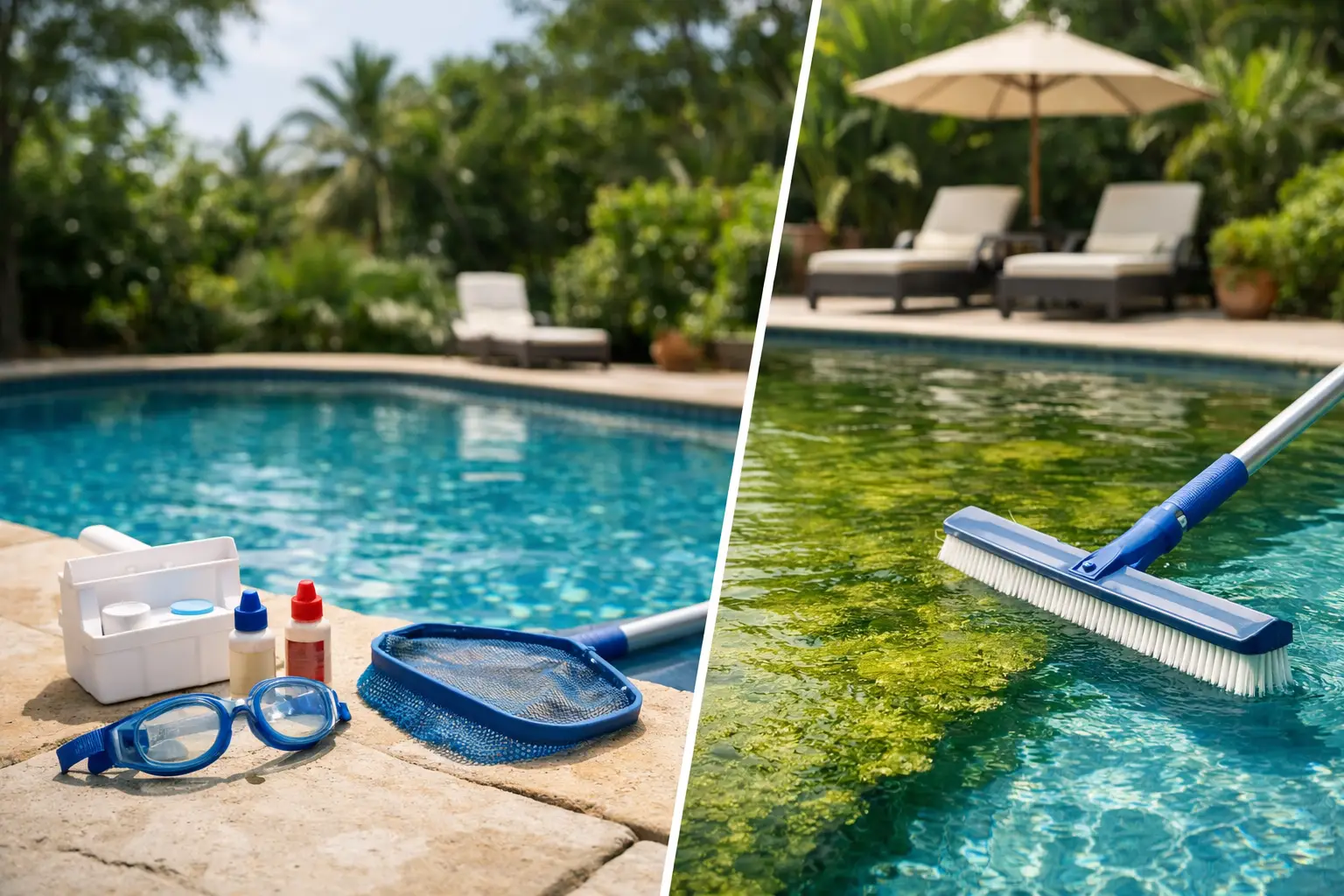
If algae is already visible, treatment may require a combination of brushing, vacuuming, filtration, chemistry correction, and appropriately managed chlorination.
The correct response depends on the pool's current chemistry and the type and severity of the algae.
Simply adding increasingly large quantities of chemicals is not necessarily the solution.
Recurring Algae May Indicate an Equipment Problem
When algae repeatedly returns after treatment, there is usually a reason.
Potential causes include:
- Inadequate circulation
- Improper pump programming
- Dirty or damaged filtration
- A failing salt chlorine generator
- Incorrect sanitizer production
- Poorly positioned return fittings
- Hidden debris
- Improper water balance
This is where professional troubleshooting becomes particularly valuable.
Treating the visible algae without correcting the underlying condition may temporarily improve the pool while allowing the same problem to return.
The Pool Sharks evaluates both water quality and equipment performance when persistent conditions suggest something deeper is occurring.
Professional Weekly Pool Service Helps Prevent Algae
Pool ownership should not require homeowners to constantly monitor test strips, troubleshoot pumps, clean filters, and wonder whether the water will still look perfect when guests arrive.
Professional weekly pool maintenance provides consistency.
Depending on the service program and pool requirements, professional care may include:
- Comprehensive water testing
- Chemical balancing
- Skimming
- Brushing
- Vacuuming
- Basket cleaning
- Equipment inspection
- Filter-pressure monitoring
- Salt-system evaluation
- Circulation checks
- Early identification of developing problems
The greatest advantage is continuity.
A service professional who understands how a particular pool normally operates can recognize when something has changed.
An unusual pressure reading, increased chlorine demand, different pump sound, or subtle change in water clarity may mean very little to someone seeing the pool for the first time.
To a technician familiar with the property, it can be an early warning.
Concierge Pool Care for Northern Virginia Homeowners
For homeowners with demanding schedules, frequent travel, seasonal residences, or luxury properties, maintaining the pool should not become another operational responsibility.
Concierge-level pool care places those details in the background.
The Pool Sharks provides professional pool maintenance, equipment service, inspections, openings, closings, renovations, and water-quality support throughout Northern Virginia.
Our service area includes communities throughout:
Loudoun County: Ashburn, Leesburg, Purcellville, Round Hill, Hamilton, Lovettsville, Middleburg, Aldie, Brambleton, Sterling, and South Riding.
Fairfax County: McLean, Great Falls, Vienna, Reston, Herndon, Oakton, Chantilly, Centreville, Fairfax, Burke, Springfield, Clifton, and Falls Church.
Prince William County: Gainesville, Haymarket, Manassas, and surrounding communities.
Fauquier County: Warrenton, Marshall, The Plains, Bealeton, New Baltimore, Catlett, and Remington.
Our objective is simple:
Keep your pool clear, polished, properly maintained, and ready when you are.
Preventing Pool Algae Is Easier Than Recovering From It
A crystal-clear swimming pool is rarely the result of luck.
It is the visible result of consistent water chemistry, dependable circulation, effective filtration, clean surfaces, properly operating equipment, and timely intervention when conditions begin to change.
Preventing algae is almost always preferable to recovering from an algae bloom.
For Northern Virginia homeowners who expect their outdoor environment to remain beautiful without constant oversight, proactive professional pool care provides something equally important to clear water:
Peace of mind.
At The Pool Sharks, that is exactly the standard we are built around.
Where Luxury Meets Peace of Mind.