
By Jason DeBosky | 30-Year Pool Industry Veteran Published by The Pool Sharks
How to Spot Swimming Pool Leaks Early: A Northern Virginia Homeowner's Guide
A swimming pool that requires frequent topping off can easily feel like a minor seasonal chore, especially during a hot, humid July or August stretch in the Mid-Atlantic. However, knowing how to spot swimming pool leaks early protects far more than your water level.
An unaddressed leak can wash away the aggregate beneath pool decks, destabilize pavers, oversaturate surrounding landscaping, burn out filtration equipment, and throw your chemical balance into disarray. For luxury pool owners across McLean, Great Falls, Vienna, Arlington, Alexandria, Ashburn, and Leesburg, early leak detection prevents minor underground plumbing issues from turning into catastrophic structural failures.
---
1. Normal Evaporation vs. A Real Pool Leak
Every outdoor pool in Northern Virginia loses a measurable amount of water to natural evaporation. The key is establishing your baseline so you can quickly identify abnormal water loss.
┌────────────────────────────────────────────────────────┐ │ ESTIMATING DAILY WATER LOSS │ ├────────────────────────────────────────────────────────┤ │ • Normal Evaporation: 1/4" to 1/2" per 24-hour cycle │ │ • Elevated Loss: Windy, unshaded, or heated pools │ │ • Suspected Leak: Consistently losing > 1/2" per day │ └────────────────────────────────────────────────────────┘
- Normal Evaporation: An uncovered swimming pool exposed to direct sun and moderate breezes in Fairfax County or Loudoun County typically loses between 1/4 inch and 1/2 inch of water per day.
- Contributing Factors: Waterfalls, sheer descents, elevated water temperatures from a gas heater or heat pump, and high swimmer splash-out will accelerate water loss.
- Red Flag Pattern: If you find yourself running the garden hose multiple times a week just to keep the water skimming properly—or your automated water leveler is constantly running—you likely have an active leak.
---
2. How to Perform the "Bucket Test" (Step-by-Step)
The Bucket Test is the gold standard DIY diagnostic to confirm whether your water loss is due to weather or a structural/plumbing leak.
THE 24-HOUR BUCKET TEST [ Pool Water Level ] ──┐ │ (Compare drops after 24 hrs) [ Bucket Interior Level] ──┘
Steps to Run the Test:
- Set the Stage: Bring your pool water to its normal operating level (midway up the skimmer throat). Turn off auto-fills, water features, and solar heaters.
- Position the Bucket: Place a standard 5-gallon bucket on the first or second pool step. Fill the bucket with pool water until the interior water level matches the pool's exterior level.
- Mark the Baseline: Use electrical tape or a waterproof grease marker to mark both the water line inside the bucket and the pool water level on the outside of the bucket.
- Wait 24 Hours: Leave the setup undisturbed for 24 hours (ensure no pets drink from it and no one swims).
- Measure the Differential:
- If both the bucket water and pool water dropped by the exact same amount, your loss is pure evaporation.
- If the pool water level dropped significantly more than the water inside the bucket, you have an active pool leak.
> Pro Diagnostic Tip: Run this test once with your filtration pump running normally, and once with the system completely powered off. If the pool loses more water while the pump runs, the leak is likely on the pressure side plumbing (returns, cleaner lines, or equipment). If it loses more water when shut down, the issue usually lies in the pool shell, light niches, or suction lines (skimmers and main drains).
---
3. Visual Clues: Inspecting Surrounding Decking & Landscape
Water escaping from a subterranean plumbing line or cracked pool shell will migrate along the path of least resistance through Northern Virginia’s dense clay soils.
┌────────────────────────────────────────────────────────────────────────┐ │ SIGNS OF UNDERGROUND WATER LOSS │ ├───────────────────────────────────┬────────────────────────────────────┤ │ Landscape & Deck Indicators │ Structural & Shell Indicators │ ├───────────────────────────────────┼────────────────────────────────────┤ │ • Soggy, spongy grass patches │ • Fine cracks in tile line or grout│ │ • Unexplained soil erosion │ • Gaps pulling away from coping │ │ • Settling or lifted stone pavers │ • Air bubbles streaming from jets │ │ • Hollow sounds behind deck slabs │ • Water line stopping at a fitting │ └───────────────────────────────────┴────────────────────────────────────┘
- Landscape Warning Signs: Look for localized soggy patches of turf, saturated mulch beds near underground plumbing trenches, or unexplained erosion around retaining walls.
- Deck Settlement & Paver Movement: Continuous water leaks erode the crushed-stone bedding beneath patios. If you observe sunken concrete sections, tilted coping stones, or uneven surfaces, review our specialized guide on pool deck leveling and repair.
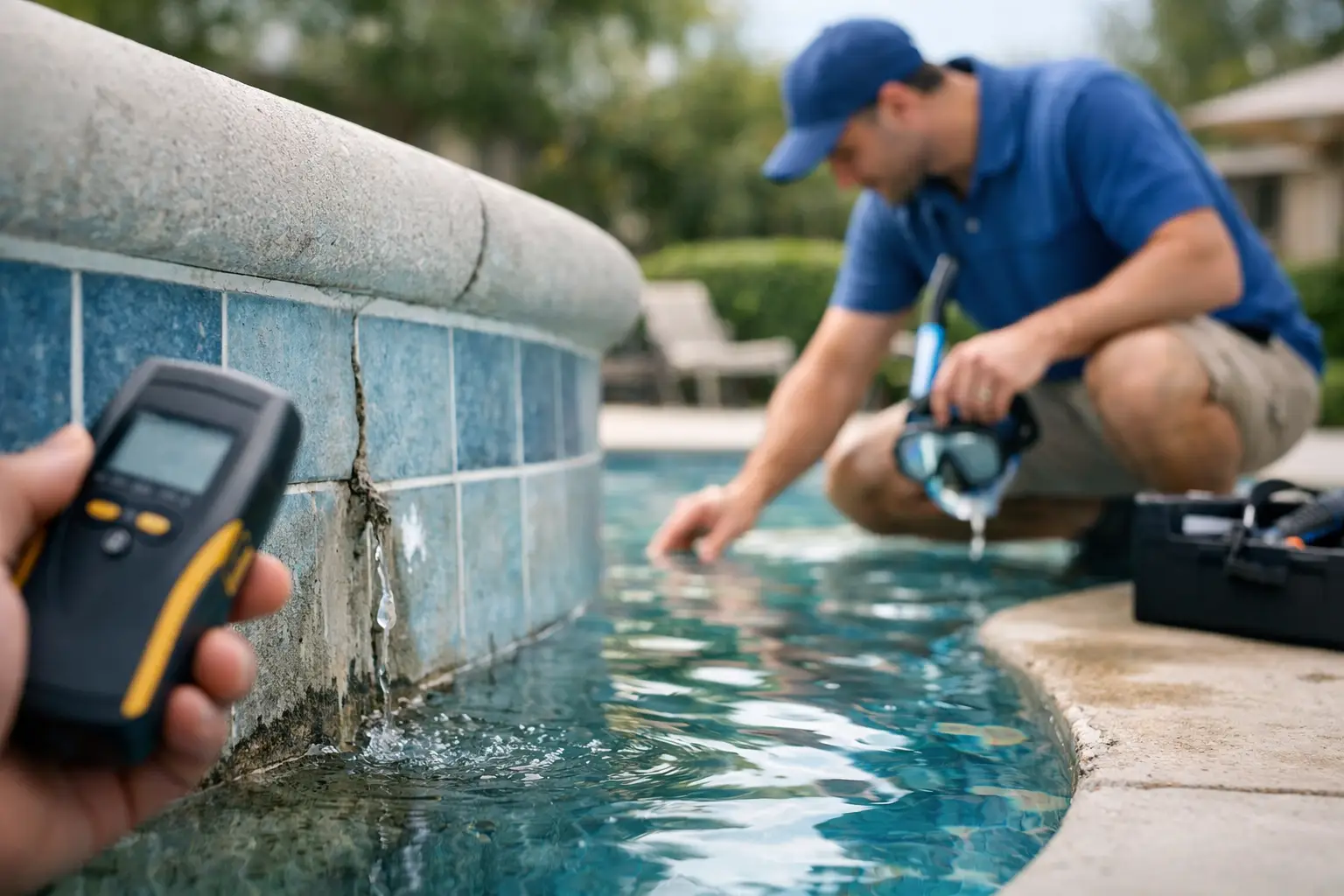
- Shell & Tile Line Separation: Check along the waterline tile, grout lines, skimmer throats, and around underwater light niches. If the water level always stops dropping at an exact height (such as the bottom of the skimmer or the top of the pool light), the leak is almost certainly located at that elevation.
---
4. Inspecting the Equipment Pad for Pressure & Suction Leaks
Before assuming a pipe is broken beneath your patio in Oakton or Clifton, conduct a thorough visual audit of your above-ground mechanical pad.
- Pressure-Side Leaks (Pump Running): Inspect the filter multiport valve, pump housing, unions, chlorinators, and heater headers. Check closely for active drips, spray, or mineral crusting around fittings. A small pinhole leak under 25 PSI of pressure can eject hundreds of gallons per day.
- Backwash / Waste Line Bypass: If your sand or DE filter has a multiport valve, a worn internal spider gasket can allow water to silently bypass continuously down the waste line even when set to "Filter."
- Suction-Side Leaks (Air in the System): If you notice continuous air bubbles churning in the pump strainer basket or spitting through return jets, air is being pulled into the suction side of the system (often through dry pump lid O-rings or cracked intake valves).
Maintain peak mechanical efficiency by referencing our comprehensive pool equipment maintenance guide.
---
5. The Impact on Pool Water Chemistry
When your pool constantly loses water, you are continuously replacing balanced, treated water with raw tap or well water. This causes noticeable operational symptoms:
- Spike in Chemical Consumption: You will struggle to maintain chlorine, stabilizer (CYA), and salt levels because the treated water is leaking out and being diluted by untreated makeup water.
- Fluctuating pH and Total Alkalinity: Municipal water across Northern Virginia counties often alters pool balance, requiring constant acid or buffer additions.
- Increased Risk of Scaling or Algae: Continuous chemical dilution leaves the pool vulnerable to rapid algae blooms and plaster scaling.
To maintain your water balance during leak diagnostics, review our expert walkthrough on pool water chemistry management.
---
6. What to Expect During a Professional Leak Detection
While visual checks and bucket tests confirm the presence of a leak, pinpointing the exact underground location requires non-destructive diagnostic tools.
Step 1: Pressure Testing Step 2: Hydrophone Audio Step 3: Precision Dye Testing ┌─────────────────────────────┐ ┌─────────────────────────────┐ ┌─────────────────────────────┐ │ Isolate individual plumbing │──>│ Use ultrasonic listening │──>│ Deliver colored dye to shell│ │ lines using sealed plugs │ │ sensors to trace underground│ │ cracks, lights, and skimmer │ │ and compressed air/nitrogen.│ │ pipe hiss through decking. │ │ seams to verify water draw. │ └─────────────────────────────┘ └─────────────────────────────┘ └─────────────────────────────┘
- Pneumatic Pressure Testing: Technicians isolate each plumbing line (skimmers, main drains, returns, cleaner lines) and pressurize them to confirm which specific pipe cannot hold pressure.
- Electronic Hydrophone Acoustic Tracing: Specialized acoustic listening gear amplifies the sound of water escaping underground through concrete decks and soil, pinpointing the dig site without tearing up entire patios.
- Targeted Dye Testing: Syringe-delivered precision dyes verify whether structural cracks, light conduit openings, or skimmer throat interfaces are actively pulling water out of the vessel.
---
Protect Your Northern Virginia Pool with The Pool Sharks
Adding water every few days is not a solution—it is a temporary mask for an escalating problem. Left untreated, a pool leak can wash out structural base material, destroy expensive mechanical equipment, and double your municipal water bill.
The Pool Sharks of Northern Virginia provides precision diagnostics, equipment pad repairs, and comprehensive pool management across the region.
Our Northern Virginia Service Areas Include:
- Fairfax County: McLean, Great Falls, Vienna, Oakton, Clifton, Reston, Herndon, Fairfax Station, Burke, Springfield, Annandale
- Loudoun County: Ashburn, Leesburg, Lansdowne, Aldie, Purcellville, South Riding, Brambleton, Sterling
- Arlington County & Alexandria: North Arlington, Country Club Hills, Old Town Alexandria, Belle Haven
Contact The Pool Sharks of Northern Virginia today to schedule an expert equipment assessment or leak inspection for your property.
---
Related Pool Care Resources
- Pool Equipment Maintenance Guide
- Pool Deck Leveling & Repair Solutions
- Understanding Pool Water Chemistry
---
The Pool Sharks of Northern Virginia Where Luxury Meets Peace of Mind.