
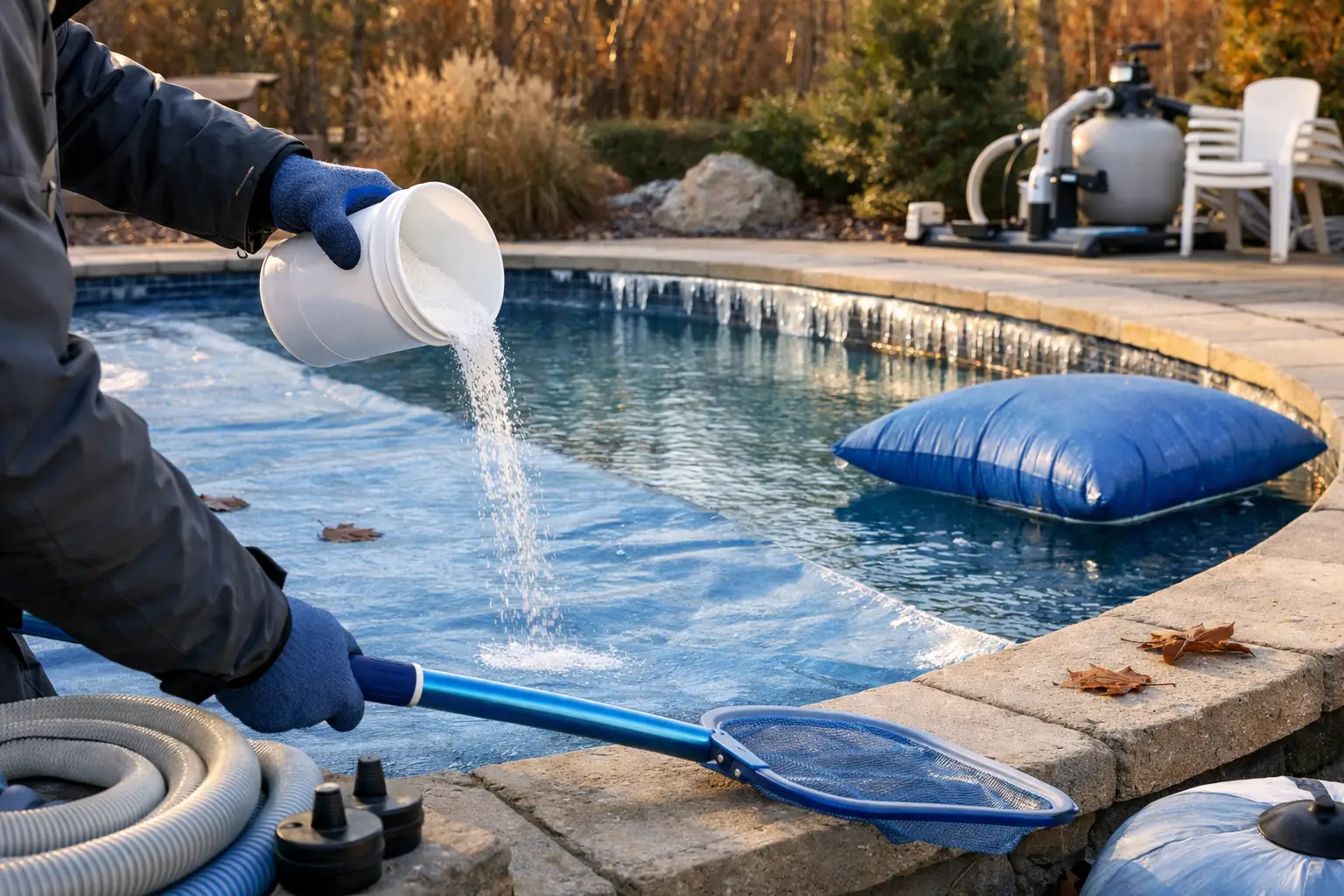
How to Winterize a Swimming Pool Properly in Loudoun, Fairfax & Fauquier Counties
By Ashton DeBosky | Owner, The Pool Sharks Published by The Pool Sharks
A pool closing is much more than putting on a cover when the weather turns cool. Properly winterizing a swimming pool protects one of the largest investments in your backyard from freeze damage, algae growth, staining, cracked plumbing, and costly spring repairs.
The goal is to leave the pool clean, chemically balanced, protected from the elements, and prepared for a smoother reopening when warm weather returns.
At The Pool Sharks, we provide professional pool closing and winterization services throughout Loudoun County, Fairfax County, and Fauquier County. Our service area includes Ashburn, Leesburg, Purcellville, Round Hill, Hamilton, Lovettsville, Aldie, Middleburg, Great Falls, McLean, Vienna, Reston, Herndon, Chantilly, Centreville, Clifton, Warrenton, Marshall, Bealeton, New Baltimore, and The Plains.
Whether you own a traditional chlorine pool, saltwater pool, attached spa, or pool with multiple water features, a properly completed winterization can prevent expensive repairs and make your spring pool opening significantly easier.
Learn more about our Professional Pool Closing Services.
Why Proper Pool Winterization Matters in Northern Virginia
Northern Virginia winters can be unpredictable. Temperatures may remain relatively mild during the day before dropping below freezing overnight.
These temperature swings can damage pool plumbing and equipment when water has not been completely removed from vulnerable components.
Professional pool winterization helps:
- Prevent frozen and cracked plumbing lines
- Protect pumps, filters, heaters, and salt systems
- Reduce off-season algae growth
- Prevent staining and scale buildup
- Preserve water quality
- Extend the life of pool equipment
- Make spring pool opening easier
- Reduce the risk of expensive repairs
Many homeowners assume closing a swimming pool simply means lowering the water and installing a cover. In reality, every pool has a different plumbing layout, equipment configuration, surface, sanitizer system, and winter cover.
A successful closing must be tailored to the individual pool.
Homeowners who want ongoing care before and after closing season can learn more about our Weekly Pool Maintenance Services.
When Should You Close Your Pool in Northern Virginia?
Timing is one of the most important parts of pool winterization.
Closing too early while daytime and water temperatures remain warm may encourage algae growth beneath the cover. Waiting too long increases the possibility of an unexpected freeze damaging exposed plumbing or equipment.
For most swimming pools throughout Loudoun, Fairfax, and Fauquier Counties, closing is generally recommended after the water temperature remains around 65 degrees Fahrenheit or lower.
Cooler water slows algae growth and allows properly selected winter chemicals to remain more effective.
The correct closing date may also depend on:
- Long-range weather forecasts
- The number of surrounding trees
- The amount of falling leaves
- Pool location and sun exposure
- Pool surface type
- Winter cover type
- Attached spas and water features
- Whether the home will be vacant
- The condition of the pool equipment
A pool surrounded by mature trees in Great Falls may require a different closing schedule than a pool with full sun exposure in Warrenton or Ashburn.
Step 1: Clean the Pool Thoroughly Before Closing
A swimming pool should never be closed with cloudy water, visible algae, or large amounts of debris.
Leaves, pollen, dirt, and other organic material can decompose beneath the cover. This may contribute to algae growth, staining, unpleasant odors, and difficult spring cleanup.
Before closing, the pool should be thoroughly cleaned by:
- Skimming leaves and floating debris
- Vacuuming the pool floor
- Brushing walls and steps
- Cleaning benches and tanning ledges
- Brushing the tile line
- Emptying skimmer baskets
- Emptying the pump basket
- Removing debris from corners
- Cleaning behind ladders and handrails
Special attention should be given to steps, sun shelves, attached spas, and areas with limited circulation. These locations often collect sediment and may develop algae before the rest of the pool.
Starting with clean water gives your winter cover a much better environment to protect.
Step 2: Test and Balance the Pool Water
Proper water chemistry protects the pool surface, plumbing, equipment, and metal components throughout the off-season.
Before winterization, the water should be tested and adjusted for:
- pH
- Total alkalinity
- Calcium hardness
- Sanitizer level
- Cyanuric acid, when applicable
- Salt level, for saltwater pools
- Metals, when staining is a concern
Water that is overly acidic may contribute to corrosion and surface deterioration. Water with excessive calcium or an elevated pH may contribute to scale formation.
The correct chemical targets may vary depending on whether the pool has a plaster, pebble, vinyl, or fiberglass surface.
Saltwater pool owners should also review the condition of their chlorine generator and salt cell. Learn more about our Saltwater Pool Services.
Step 3: Add the Correct Winterizing Chemicals
After the water is properly balanced, winter treatment products may be added.
Depending on the pool, these products may include:
- Chlorine shock
- Winter algaecide
- Stain and scale preventative
- Enzyme treatments
- Metal control products
More chemicals are not necessarily better.
Overdosing a pool can create its own problems, particularly in swimming pools with sensitive finishes, elevated chlorine levels, or saltwater systems.
The amount and type of winter chemicals should be based on:
- Pool volume
- Existing chemistry
- Pool surface
- Sanitizer system
- Water temperature
- Expected closing date
- Cover type
After the products are added, the circulation system should operate long enough to distribute them throughout the pool.
Step 4: Lower the Water to the Correct Level
Water level is one of the most misunderstood parts of pool winterization.
The correct winter water level depends on:
- Mesh safety covers
- Solid safety covers
- Automatic pool covers
- Skimmer configuration
- Pool surface type
- Vinyl liner requirements
- Tile location
- Local freeze conditions
- Manufacturer recommendations
For many traditional in-ground pools, the water is lowered beneath the skimmer opening to help prevent water from entering and freezing inside the skimmer throat.
However, lowering the water excessively may create other concerns. It can place unnecessary stress on certain cover systems and expose more of the pool surface to air, debris, or staining.
Vinyl-lined pools require particular care because removing too much water may affect liner stability.
Two neighboring pools may require different water levels based on their construction and cover systems. The water level should be determined by the needs of the individual pool—not by a one-size-fits-all measurement.
Step 5: Blow Out and Protect the Plumbing Lines
Removing water from the plumbing system is one of the most important technical steps in a professional pool closing.
Water expands when it freezes. Water trapped inside a plumbing line may crack pipes, split fittings, damage valves, and compromise expensive pool equipment.
Lines that may require winterization include:
- Skimmer lines
- Return lines
- Cleaner lines
- Main drain systems
- Spa suction lines
- Spa return lines
- Water feature plumbing
- Fountain lines
- Bubblers
- Deck jets
- Slide plumbing
- Automatic cleaner lines
A professional high-volume blower is commonly used to evacuate water from the plumbing.
Once a line is clear, it is sealed using the proper winter plug or valve procedure.
Why a Small Air Compressor May Not Be Enough
A small air compressor may create pressure without moving enough air volume to completely clear underground pool plumbing.
Too little airflow may leave water trapped in low areas. Excessive air pressure may damage fittings, valves, seals, or equipment.
Professional pool blowers are designed to move a high volume of air at controlled pressure. This helps clear plumbing safely and consistently.
The process should be deliberate, not rushed. Each plumbing line should be identified, cleared, and protected individually.
Step 6: Drain and Protect Pool Equipment
Pool equipment must also be properly drained and prepared for freezing temperatures.
Equipment that may require attention includes:
- Pool pumps
- Cartridge filters
- Sand filters
- Diatomaceous earth filters
- Gas heaters
- Heat pumps
- Booster pumps
- Chlorinators
- Salt chlorine generators
- Ozone systems
- Automation equipment
- Water feature pumps
Drain plugs should be removed from applicable equipment and stored in a clearly marked location.
Filters should be cleaned according to their type. Heater passages require particular attention because water trapped inside a heat exchanger can cause significant freeze damage.
If worn, leaking, or damaged components are discovered during closing, visit our Pool Equipment Repair and Upgrade Services.
Winterizing Saltwater Pool Equipment
Saltwater pools require additional attention during the closing process.
The salt cell should be inspected and cleaned when needed. Depending on the system and manufacturer instructions, the cell may need to be removed, protected, or stored for the winter.
Automation systems should be placed in the correct seasonal mode. Freeze protection settings should be reviewed rather than automatically relied upon after the circulation system has been shut down.
Step 7: Winterize Attached Spas and Water Features
Attached spas, raised spillovers, fountains, tanning ledge bubblers, deck jets, and waterfalls add more plumbing branches to the pool system.
Each feature should be identified and winterized separately.
A forgotten spa return, bubbler, fountain, or deck jet line can freeze even when the primary pool plumbing was winterized correctly.
Special features that may require additional attention include:
- Raised spas
- Spillways
- Tanning ledge bubblers
- Fountains
- Deck jets
- Waterfalls
- Slides
- Separate feature pumps
- In-floor cleaning systems
Complex swimming pools throughout areas such as Great Falls, McLean, Middleburg, and Aldie often have multiple plumbing systems that require a detailed closing process.
Step 8: Remove and Store Pool Accessories
Removable pool accessories should be cleaned and stored in a dry, secure location.
These may include:
- Ladders
- Handrails
- Skimmer baskets
- Return fittings
- Pool cleaners
- Robotic cleaners
- Solar blankets
- Floating accessories
- Basketball hoops
- Volleyball nets
- Removable fountains
- Poolside toys
Metal ladders and handrails should not be left in the pool when they are intended to be removed for winter. Metal components can contribute to staining and may be damaged by winter weather.
Robotic pool cleaners should never be left beneath the winter cover. The cleaner should be washed, inspected, dried, and stored according to manufacturer instructions.
Step 9: Install the Correct Winter Pool Cover
A properly installed winter cover is the final layer of protection.
A quality cover helps:
- Keep leaves and debris out
- Reduce sunlight exposure
- Limit algae growth
- Improve safety
- Preserve water quality
- Reduce spring cleanup
- Protect the appearance of the pool
Before installation, the cover should be inspected for:
- Tears
- Damaged seams
- Worn straps
- Weak springs
- Missing hardware
- Damaged anchors
- Improper fit
The cover should be evenly tensioned and secured around the perimeter. Large gaps may allow leaves, debris, or animals beneath the cover.
Mesh Safety Covers vs. Solid Safety Covers
Mesh and solid safety covers both provide important benefits.
Mesh safety covers allow rain and melting snow to drain through the material. They are generally lighter and do not require a cover pump. However, fine debris and some sunlight may pass through the mesh.
Solid safety covers block more sunlight and debris. This may help improve spring water clarity, but standing rainwater and melting snow usually need to be removed with a cover pump.
The right choice depends on the pool, surrounding landscape, maintenance expectations, and homeowner preferences.
Read our complete comparison of Mesh Safety Covers vs. Solid Safety Covers.
Common Pool Closing Mistakes Homeowners Make
Even a small winterization mistake can result in expensive repairs.
Common mistakes include:
- Closing the pool too early
- Closing cloudy or green water
- Failing to balance the chemistry
- Adding excessive winter chemicals
- Lowering the water too far
- Leaving water inside plumbing lines
- Forgetting a spa or water feature line
- Failing to drain the heater
- Leaving drain plugs installed
- Using incorrect winter plugs
- Leaving accessories in the pool
- Installing a damaged safety cover
- Ignoring the pool all winter
A professional closing reduces the risk of these oversights and creates a more reliable transition into winter.
Should You Check Your Pool During the Winter?
Closing a pool does not mean it should be ignored until spring.
Periodic winter inspections can help identify:
- Falling water levels
- Cover damage
- Loose straps or springs
- Standing water on solid covers
- Excessive debris
- Storm damage
- Animals beneath the cover
- Unexpected algae growth
- Equipment concerns
Homeowners who want continued off-season attention can learn more about our Year-Round Pool Maintenance Services.
Maintaining proper water chemistry and debris control throughout fall, winter, and early spring may reduce staining, scaling, algae growth, and stress on equipment during reopening.
Why Professional Pool Closings Can Save Money
Professional pool winterization is an investment in prevention.
A properly closed pool is more likely to experience:
- Easier spring openings
- Less algae growth
- Reduced staining
- Fewer plumbing repairs
- Longer equipment life
- Cleaner water
- Lower spring cleanup costs
One cracked pipe, damaged heater, broken valve, or freeze-damaged filter can cost considerably more than a professional seasonal closing.
For complete seasonal care, homeowners may combine our Pool Closing Services, Pool Opening Services, Weekly Pool Maintenance, and Year-Round Pool Service.
Why Northern Virginia Homeowners Choose The Pool Sharks
At The Pool Sharks, we approach pool closing as stewardship of the entire pool environment—not as a rushed end-of-season checklist.
Our closing process focuses on:
- Proper water preparation
- Detailed plumbing winterization
- Equipment protection
- Cover installation
- Identification of potential concerns
- Clear seasonal planning
- Concierge-level service
Every swimming pool is different. We evaluate the pool surface, plumbing, equipment, sanitizer system, cover type, and water features before completing the winterization process.
Our objective is to protect your backyard investment and make the following spring opening as smooth as possible.
Pool Closing Services in Loudoun County
The Pool Sharks provides professional pool closing services throughout Loudoun County, including:
- Ashburn
- Leesburg
- Purcellville
- Round Hill
- Hamilton
- Lovettsville
- Aldie
- Middleburg
- Brambleton
- South Riding
- Sterling
Pool Closing Services in Fairfax County
We also provide pool winterization services throughout Fairfax County, including:
- Great Falls
- McLean
- Vienna
- Reston
- Herndon
- Oakton
- Chantilly
- Centreville
- Clifton
Pool Closing Services in Fauquier County
Our Fauquier County pool closing service area includes:
- Warrenton
- Marshall
- Bealeton
- New Baltimore
- The Plains
- Broad Run
- Catlett
- Delaplane
Frequently Asked Questions About Pool Winterization
What Month Should I Close My Pool in Northern Virginia?
Many Northern Virginia pools are closed during September, October, or early November.
The best date depends on water temperature, weather conditions, surrounding trees, and how long the homeowner plans to continue using the pool.
Waiting until water temperatures remain near 65 degrees Fahrenheit or lower may help reduce algae growth beneath the cover.
Can I Winterize My Own Swimming Pool?
An experienced homeowner with a straightforward pool system may be able to complete some parts of the winterization process.
However, clearing plumbing lines, protecting heaters, winterizing attached spas, and identifying every water feature line require the correct equipment and knowledge.
A mistake may remain hidden until the pool is reopened in spring.
What Happens if a Pool Line Is Not Blown Out Correctly?
Water remaining in a plumbing line can freeze and expand.
This may crack underground pipes, damage fittings, split valves, or compromise connected equipment.
The damage may not become visible until the system is restarted during the spring opening.
Should I Lower the Water Below the Skimmer?
Many traditional in-ground pools are lowered beneath the skimmer opening, but the correct level depends on the pool surface, skimmer system, and winter cover.
The water should not automatically be lowered to the same level in every pool.
Should I Add Antifreeze to Pool Plumbing?
Pool antifreeze may be used in certain systems as an additional precaution, but it should never replace properly clearing the plumbing lines.
Only antifreeze specifically labeled for swimming pool plumbing should be used. Automotive antifreeze should never be placed in pool plumbing.
Does a Saltwater Pool Need to Be Winterized?
Yes. Saltwater pools still contain plumbing, pumps, filters, heaters, and other components that can be damaged by freezing.
The salt cell and chlorine-generation system also require appropriate seasonal care.
Does a Pool Need Maintenance After It Has Been Closed?
Periodic inspections are recommended.
The water level, winter cover, straps, springs, cover pump, and equipment area should be checked throughout the off-season, especially after severe storms.
Schedule Professional Pool Closing Services
Protect your swimming pool before freezing temperatures arrive.
Whether you need a traditional pool closing, saltwater pool winterization, attached spa closing, safety cover installation, or complete concierge-level seasonal care, The Pool Sharks can help protect your pool throughout the Northern Virginia winter.
Visit our Pool Closing Services page or Contact The Pool Sharks to request service.
Continue Learning About Pool Care
Explore additional Pool Sharks services and educational resources:
- Pool Opening Services
- Weekly Pool Maintenance
- Year-Round Pool Service
- Saltwater Pool Services
- Mesh Safety Covers vs. Solid Safety Covers
- Pool Equipment Repair and Upgrades
- Professional Pool Inspections
Continue Exploring Pool Care
Continue with professional pool closing service, Pool Closing Service Cost for Premium Pool Care, Northern Virginia service areas, and request private client access. These resources help Northern Virginia homeowners connect practical guidance with the appropriate professional service.