
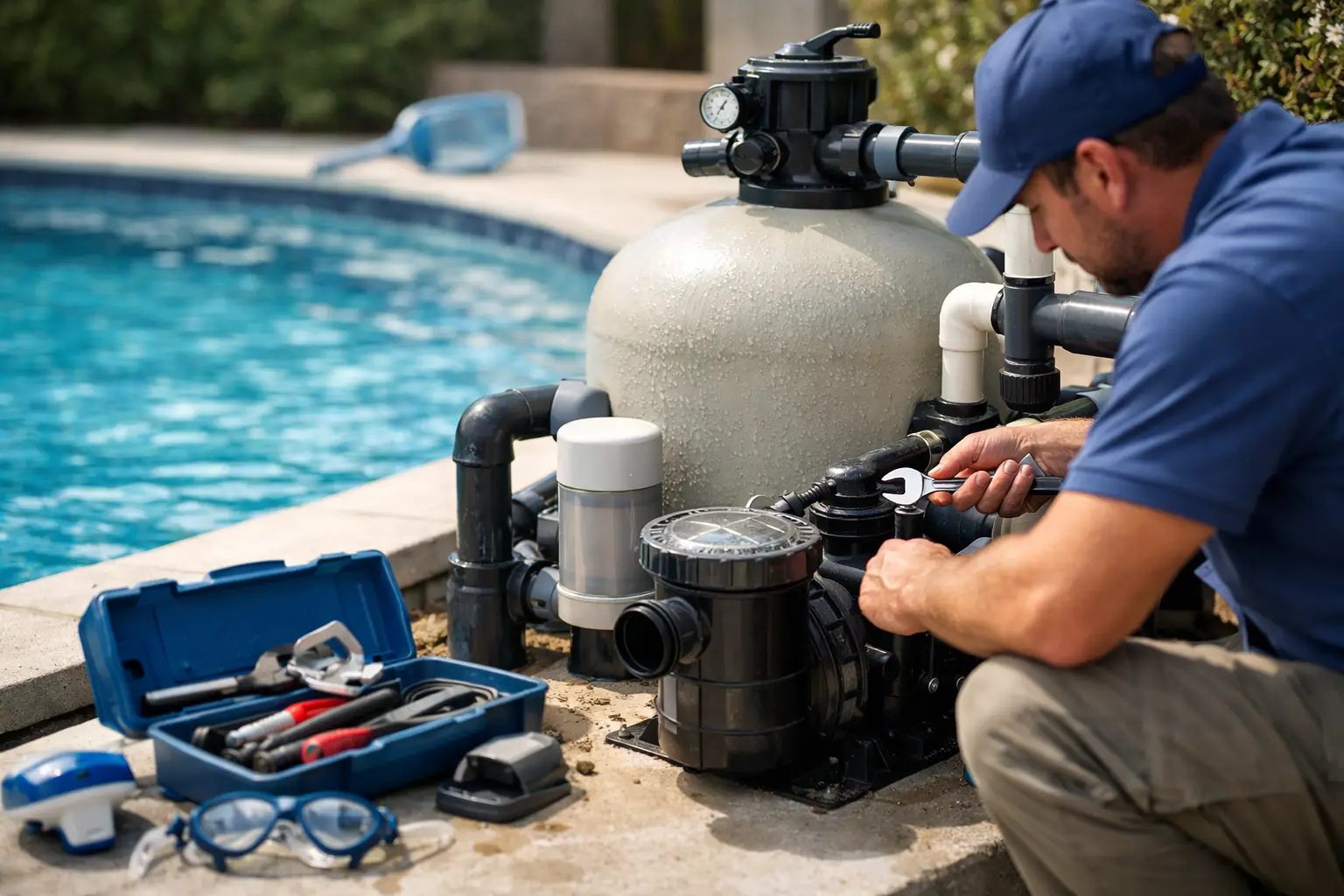
Pool Equipment Repair Guide: Warning Signs Every Homeowner Should Know
By Ashton DeBosky | Owner, The Pool Sharks Published by The Pool Sharks
A pool rarely fails without leaving a clue. A slightly louder pump, a heater that takes longer to warm the water, or a damp spot near the equipment pad can all signal an issue that deserves attention. This pool equipment repair guide helps homeowners recognize those signs early, understand what is safe to check, and know when a professional repair protects both the system and the experience of owning a well-kept pool.
For a luxury property, pool equipment is not an afterthought hidden behind landscaping. It is the operating system behind clear water, comfortable temperatures, quiet circulation, and a backyard that is ready when you are. Prompt, informed care preserves that standard.
Start With Safe, Simple Observation
Before inspecting any equipment, turn off power at the appropriate breaker when working near electrical components or opening a pump basket. Never handle wiring, remove motor covers, or attempt a heater repair while power or gas service is active. Water, electricity, and gas are a combination best left to qualified technicians once the issue moves beyond a visual inspection.
Start by observing the system during a normal circulation cycle. Note whether water is moving strongly through the returns, whether the pump is unusually loud, and whether the filter pressure has changed from its normal operating range. Keep an eye out for drips, pooling water, error codes, air bubbles under the pump lid, and water loss that cannot be explained by evaporation.
A simple record of equipment behavior is surprisingly useful. If a pump begins to hum at startup, for example, knowing whether it happens every day, only after heavy rain, or only when the heater is running gives a service professional a clearer starting point. It also helps distinguish a one-time interruption from a developing mechanical issue.
Pool Equipment Repair Guide: The Most Common Issues
Pump Problems: Noise, Weak Flow, and Air Leaks
The circulation pump does some of the hardest work in the system. When it is operating properly, it should produce steady flow with a consistent sound. A sudden grinding, screeching, or high-pitched whine can point to worn bearings, a failing motor, or debris affecting the impeller.
Weak water flow is often less dramatic but just as consequential. First, check whether the skimmer and pump baskets are full of leaves or debris. A clogged basket can restrict circulation and strain the motor. If the baskets are clear but the pump lid shows persistent air bubbles, the issue may be a compromised lid O-ring, a loose fitting, a low water level, or a suction-side leak.
Lubricating a clean pump-lid O-ring with a pool-safe lubricant and ensuring the lid is seated correctly may resolve a minor air leak. Repeated priming failures, visible leaks near the seal plate, or a pump that trips a breaker require professional attention. Continuing to run a pump that is not fully primed can damage the seal and motor.
Filter Concerns: Pressure Tells a Story
Your filter pressure gauge offers one of the clearest indicators of circulation health. Every pool has a normal clean pressure, and it is wise to record it after the filter has been professionally cleaned or serviced. A rise of roughly 20 to 25 percent above that baseline usually indicates that the filter needs cleaning.
High pressure can result from a dirty cartridge, a blocked grid assembly, a clogged sand filter, or a restriction after the filter. Low pressure can suggest insufficient water reaching the pump, a blocked impeller, a suction leak, or a valve that is not positioned correctly.
Homeowners can empty baskets and confirm that visible valves are open as intended. Filter disassembly, media replacement, and internal inspections are more technical. Cartridge filters can be damaged by aggressive washing, while improper backwashing or reassembly can compromise filtration performance. The right service approach depends on the filter type, its age, and the pool’s recent water conditions.
Heater Issues: Do Not Ignore Error Codes
A pool heater that will not ignite, shuts down unexpectedly, or displays an error code can be frustrating—particularly before a weekend gathering or during the first cool stretch of the season. Sometimes the cause is straightforward: inadequate water flow, a dirty filter, a closed valve, or a thermostat setting that has been changed inadvertently.
However, heater troubleshooting quickly crosses into safety-sensitive territory. Gas supply, ignition systems, combustion chambers, pressure switches, and electrical controls should be evaluated by a qualified pool technician. Do not repeatedly reset a heater or attempt to bypass an error code. Persistent cycling can be a symptom of a condition that will worsen with continued operation.
Professional service can determine whether the repair is a modest sensor or pressure-switch replacement, a maintenance issue such as internal cleaning, or a larger decision involving an aging heat exchanger. That distinction matters. Investing in a repair can be sensible for a well-maintained unit, while an older heater with recurring failures may warrant a replacement plan that improves efficiency and reliability.
Automation and Electrical Faults: Convenience Depends on Precision
Modern pool systems may coordinate pumps, lights, heaters, water features, sanitizers, and remote controls from one panel. When automation stops responding, the issue could be as simple as a tripped GFCI outlet, a depleted remote battery, or a lost schedule after a power interruption.
Check the display for alerts, confirm that the system clock is correct, and look for a visibly tripped breaker. Beyond those basic checks, avoid opening control panels or adjusting wiring. A problem with a relay, transformer, actuator, or communication cable requires accurate diagnosis. Random setting changes can create more confusion, especially when a variable-speed pump or heater interlock is involved.
Leaks Around the Equipment Pad
Not every wet area is a major leak. Condensation around a heater may be normal, and a small amount of water after cleaning the filter can be expected. A persistent puddle, mineral deposits around fittings, or a noticeable drop
Continue Exploring Pool Care
Continue with pool equipment repair and diagnostics, Equipment Repairs and Maintenance for Pools, How to Choose Pool Service for a Pristine Pool, Northern Virginia service areas, and request private client access. These resources help Northern Virginia homeowners connect practical guidance with the appropriate professional service.