
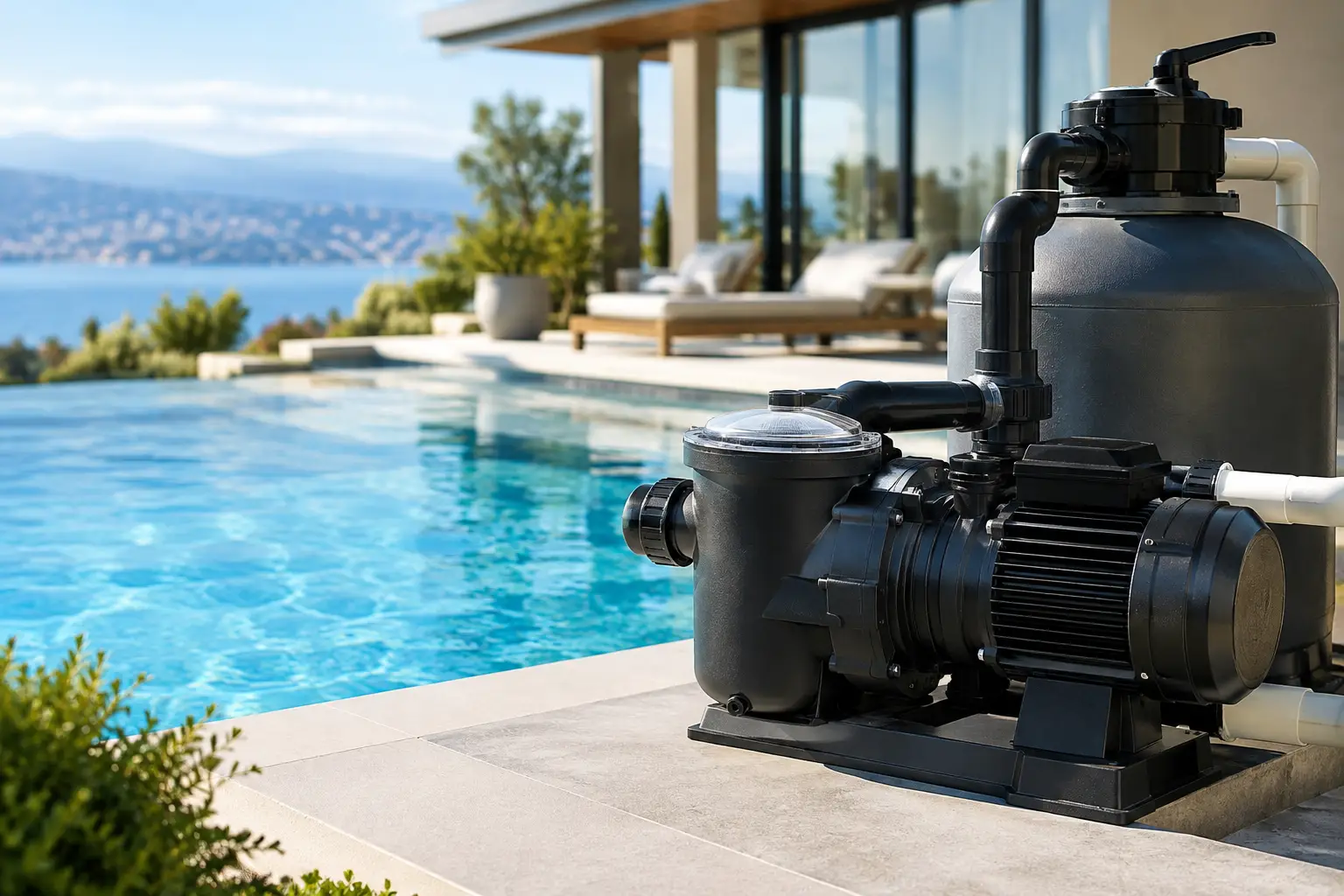
Best Pool Pumps for Northern Virginia Pools
By Ashton DeBosky | Owner, The Pool Sharks Published by The Pool Sharks
A pool pump is easy to overlook when the water is clear, quiet, and inviting. When it begins humming loudly, losing circulation, or increasing operating costs, however, it quickly becomes the equipment decision that affects the entire pool ownership experience.
The best pool pump reviews should do more than compare horsepower, prices, and advertised energy savings. They should help homeowners understand which pump will protect water quality, operate quietly, integrate with existing equipment, and perform reliably under real-world conditions.
The Pool Sharks provides luxury pool service and equipment expertise throughout Northern Virginia. For homeowners in Loudoun, Fairfax, Fauquier, and portions of Prince William County, choosing the right pump means matching it to the pool’s plumbing, filtration, automation, heating, water features, and daily use.
For a premium gunite pool, the right choice is rarely the least-expensive replacement. It is the pump that supports the entire pool system while protecting the quiet, polished atmosphere of the backyard.
What Pool Pump Reviews Should Actually Tell You
Many online pool pump reviews focus on immediate impressions. A homeowner may mention that the pump arrived quickly, was easy to install, or sounded quieter than the equipment it replaced.
Those observations can be helpful, but they do not tell the complete story.
A meaningful pool pump review should answer questions such as:
- Does the pump maintain proper circulation at lower speeds?
- Is it noticeably quieter during normal filtration?
- Does it communicate with the existing automation system?
- Can it provide enough flow for the spa, heater, cleaner, and water features?
- Are replacement parts readily available?
- Can qualified local technicians service it?
- Does it continue performing reliably after several seasons?
The most useful reviews usually come from pools with a similar equipment configuration. A pump that performs well on a small plunge pool may not be suitable for a large gunite pool with a raised spa, heater, cleaner, waterfall, and long plumbing runs.
Pool equipment is not one-size-fits-all, even when two pools appear similar from the surface.
Look Beyond Pool Pump Star Ratings
A five-star rating may describe a smooth purchase rather than years of dependable operation. Read reviews for specific information about noise, energy use, automation compatibility, error codes, warranty support, and service experiences.
Reviews are more valuable when they identify:
- Pool size and approximate water volume
- Plumbing size
- Filter type
- Attached spa or water features
- Heating equipment
- Sanitizing system
- Previous pump model
- Length of ownership
It is also important to separate pump problems from installation problems. A highly rated pump may perform poorly if it is undersized, oversized, incorrectly programmed, or installed with restrictive plumbing.
Conversely, a properly selected and calibrated pump can deliver excellent performance even when general consumer reviews are mixed.
Variable-Speed Pumps Set the Residential Standard
For most premium residential pools, variable-speed pumps deserve the closest consideration. Unlike single-speed equipment that operates at one fixed output, a variable-speed pump can run at lower speeds for routine filtration and increase its speed when additional flow is required.
That flexibility can provide several advantages:
- Quieter routine operation
- Lower electrical consumption
- Longer circulation periods
- Reduced stress on some equipment components
- Custom settings for spas and water features
- Better control over filtration and heating
- More precise seasonal programming
Higher speeds can be scheduled for spa operation, vacuuming, heating, water features, or periods of heavier swimming. Lower speeds can maintain everyday circulation without running the motor at maximum output all day.
The trade-off is a higher initial cost and a greater need for correct installation and programming.
A variable-speed pump is only as efficient as its schedule. Running it faster than necessary can eliminate much of its operating advantage. Running it too slowly may leave skimmers underperforming, heaters unable to activate, or water features looking weak.
Pump Programming Should Match the Property
Generic pump schedules do not account for how a particular pool is designed or used.
Correct programming should consider:
- Pool volume
- Plumbing configuration
- Filter size
- Number of skimmers and drains
- Swimmer load
- Seasonal temperature changes
- Sanitizer system
- Heating requirements
- Spa operation
- Water-feature schedules
- The homeowner’s preferred operating hours
A pool in Great Falls with a raised spa and multiple waterfalls may require a different schedule than a streamlined pool in Ashburn with fewer hydraulic demands.
The same applies to properties in McLean, Vienna, Leesburg, Reston, and Clifton. Equipment settings should reflect the actual pool—not a factory default or a schedule copied from another property.
Professional weekly pool maintenance allows pump performance, water clarity, filter pressure, and skimmer action to be monitored together. The schedule can then be adjusted as weather, swimmer demand, and seasonal conditions change.
Quiet Pool Pump Operation Matters
Noise appears frequently in pool pump reviews, and for good reason. A loud motor can change the atmosphere of a backyard, especially when the equipment is located near a patio, bedroom, guest area, or neighboring property.
Variable-speed pumps are often quieter during everyday filtration because they spend more time operating at reduced RPMs. However, the motor is not always the only source of noise.
Excessive sound or vibration can also come from:
- An uneven equipment pad
- Loose mounting hardware
- Restricted suction plumbing
- Air entering the system
- Aging valves
- Worn motor bearings
- Excessively high pump speeds
- Improper pipe support
Even a premium pump may sound unpleasant if it is installed incorrectly.
For properties in close-set communities such as Vienna, Fairfax, Reston, Herndon, Brambleton, and South Riding, quiet equipment can be particularly important. It protects both the homeowner’s outdoor environment and the comfort of nearby neighbors.
Quiet operation is not merely a convenience. It is part of the refined experience expected from a professionally managed luxury pool.
Match the Pump to the Complete Pool System
One of the most common equipment mistakes is selecting a pump based on horsepower alone. More horsepower does not automatically produce a better result.
An oversized pump can create excessive water velocity, loud plumbing, inefficient operation, and unnecessary pressure on filters, heaters, and other components. An undersized pump may struggle to support adequate skimming, heating, filtration, or water-feature performance.
A professional pump assessment considers:
- Pool size and shape
- Approximate water volume
- Pipe diameter and length
- Elevation changes
- Number of suction and return lines
- Skimmers and main drains
- Filter type and capacity
- Heater requirements
- Spa jets
- Waterfalls and fountains
- Pressure-side or suction-side cleaners
- Sanitizing equipment
A simple rectangular pool has very different hydraulic requirements from a large pool with a raised spa, waterfall, heater, cleaner, and long underground plumbing runs.
Before purchasing equipment, a professional pool inspection can identify whether the existing pump was correctly sized and whether the surrounding equipment can support the proposed replacement.
Automation Compatibility Must Be Confirmed
Many premium Northern Virginia properties use automation to coordinate pumps, lighting, heating, sanitization, spas, and water features.
Before selecting a new pump, confirm whether it can communicate with the existing control system. Compatibility may depend on the pump manufacturer, automation panel, software version, wiring, communication cable, and available control relays.
A pump may operate independently but fail to provide the convenient control the homeowner expects from the automation system.
If automation is important, review:
- Pump-to-panel compatibility
- Available speed controls
- Spa-mode operation
- Heater communication
- Water-feature programming
- Remote-app functions
- Scheduling capabilities
- Future equipment upgrades
A well-integrated pump should make the pool easier to operate. It should not introduce another separate control that complicates the owner’s experience.
Measure Energy Efficiency Through Daily Operation
Energy efficiency is one of the strongest reasons to consider a variable-speed pump. However, efficiency should be measured through actual daily operation rather than a single advertised number.
The practical question is how much energy the pump uses throughout the season while maintaining clean water, effective skimming, proper sanitization, and dependable equipment performance.
The lowest possible speed is not always the correct setting. The pump must still move enough water to:
- Support the filter
- Operate the skimmers
- Circulate sanitizer
- Activate the heater when needed
- Supply attached water features
- Prevent stagnant areas
- Maintain consistent water quality
Northern Virginia pools face major seasonal changes. Spring pollen in Loudoun County, summer heat in Fairfax County, and heavy storm debris throughout Fauquier and Prince William counties can all affect circulation needs.
A professional can adjust pump speeds and run times as conditions change rather than allowing one generic schedule to operate all season.
Consider Serviceability Before Buying a Pool Pump
A pool pump is a long-term equipment investment, but it is not maintenance-free. Pump baskets, lids, seals, O-rings, motors, electronics, wiring, and unions all require periodic attention.
Before selecting a pump, consider:
- Availability of replacement parts
- Manufacturer warranty coverage
- Local technical support
- Access to qualified service technicians
- Equipment-pad accessibility
- Compatibility with existing plumbing
- Expected repair costs
- Availability of replacement motors or drive assemblies
This is especially important for homeowners who travel, maintain seasonal residences, or prefer a hands-off ownership experience.
A pump failure during a summer gathering is not the time to discover that a replacement component is unavailable or that the pump cannot communicate with the existing automation panel.
The Pool Sharks approaches pool equipment repair and maintenance as part of the complete pool-care plan—not simply as an isolated product sale.
When Pool Pump Repair Makes Sense
Not every pump problem requires replacement. Some issues can be corrected through a focused repair.
Repair may be appropriate when the problem involves:
- A leaking shaft seal
- A worn lid O-ring
- A damaged pump lid
- A clogged impeller
- A failing capacitor
- Loose electrical connections
- Air entering through a plumbing fitting
- A damaged union or valve
The decision depends on the pump’s age, condition, repair history, and availability of replacement parts.
A clear professional recommendation should explain what the repair will correct, what it will not correct, and how much useful life the existing pump may have remaining.
When Pool Pump Replacement Is the Better Choice
Replacement may be more sensible when the pump has recurring failures, persistent bearing noise, deteriorated electronics, declining performance, or an older single-speed motor.
A professional pool pump replacement may provide:
- Quieter operation
- Improved scheduling
- Lower electrical use
- Better automation control
- More consistent circulation
- Improved spa and water-feature performance
- Reduced risk of recurring service interruptions
However, installing a new pump can expose weaknesses elsewhere in the equipment system. An aging filter, restrictive plumbing layout, outdated automation panel, or undersized electrical circuit may also need attention.
Addressing connected equipment concerns together can create a cleaner installation and reduce repeated disruptions.
How Northern Virginia Conditions Affect Pool Pumps
Pools across Northern Virginia operate under demanding and constantly changing conditions.
Spring pollen can quickly load filters and reduce circulation. Summer heat increases sanitizer demand and encourages algae growth. Heavy storms introduce leaves, mulch, soil, and other debris. Fall leaf accumulation can block baskets and restrict suction.
Properties in wooded areas such as Great Falls, McLean, Oakton, Clifton, and The Plains may place heavier debris demands on pumps and filters. Pools in Ashburn, Leesburg, Sterling, Brambleton, Aldie, and South Riding may experience different landscaping, plumbing, and usage conditions.
Properties in Gainesville, Haymarket, Warrenton, Marshall, and Purcellville may also contend with windblown debris, longer plumbing runs, and larger outdoor environments.
The correct pump and schedule must account for the pool’s real conditions throughout the season.
Frequently Asked Questions About Pool Pumps
Is a variable-speed pool pump worth the investment?
For many residential pools, yes. Variable-speed pumps can operate more quietly, provide flexible programming, and use less electricity during lower-speed circulation. The actual benefit depends on correct sizing and programming.
Is a higher-horsepower pump always better?
No. An oversized pump can create excessive flow, noise, inefficiency, and unnecessary stress on other equipment. Pump selection should be based on the complete hydraulic system.
Why is my pool pump suddenly loud?
Common causes include worn bearings, vibration, restricted suction, air leaks, debris in the impeller, or operation at unnecessarily high speeds. A professional inspection can identify the source.
Can any variable-speed pump work with my automation?
No. Compatibility depends on the pump, automation system, available communication connections, and software. Confirm compatibility before purchasing equipment.
Should I repair or replace my pool pump?
Repair may make sense for a newer pump with an isolated problem. Replacement may be better for an older pump with recurring failures, excessive noise, outdated controls, or declining performance.
Choose The Pool Sharks for Pool Pump Service
Online reviews can help narrow the options, but the final decision should be based on the pool’s actual plumbing, equipment, features, and daily use.
The Pool Sharks provides luxury pool service, equipment evaluation, repair, and replacement throughout Northern Virginia. We serve homeowners across Loudoun County, Fairfax County, Fauquier County, and select communities in Prince William County.
Our service area includes McLean, Great Falls, Vienna, Reston, Herndon, Oakton, Fairfax, Clifton, Chantilly, Centreville, Ashburn, Leesburg, Sterling, Brambleton, Aldie, South Riding, Purcellville, Gainesville, Haymarket, Warrenton, Marshall, The Plains, and surrounding communities.
Your pool pump should operate quietly, efficiently, and reliably without competing for your attention. When it begins affecting circulation, comfort, or operating costs, The Pool Sharks can evaluate the complete system and recommend the right solution for the property.
The Pool Sharks — Where Luxury Meets Peace of Mind.
Related Pool Equipment Articles
- Best Variable-Speed Pumps
- Pool Pump Replacement
- Pool Equipment Repairs and Maintenance
- Professional Pool Inspections
- Weekly Pool Maintenance
- Pool Heater Repair
Continue Exploring Pool Care
Continue with pool equipment repair and diagnostics, Best Variable Speed Pumps for Luxury Pools, When to Schedule a Pool Pump Repair Service, Northern Virginia service areas, and request private client access. These resources help Northern Virginia homeowners connect practical guidance with the appropriate professional service.