
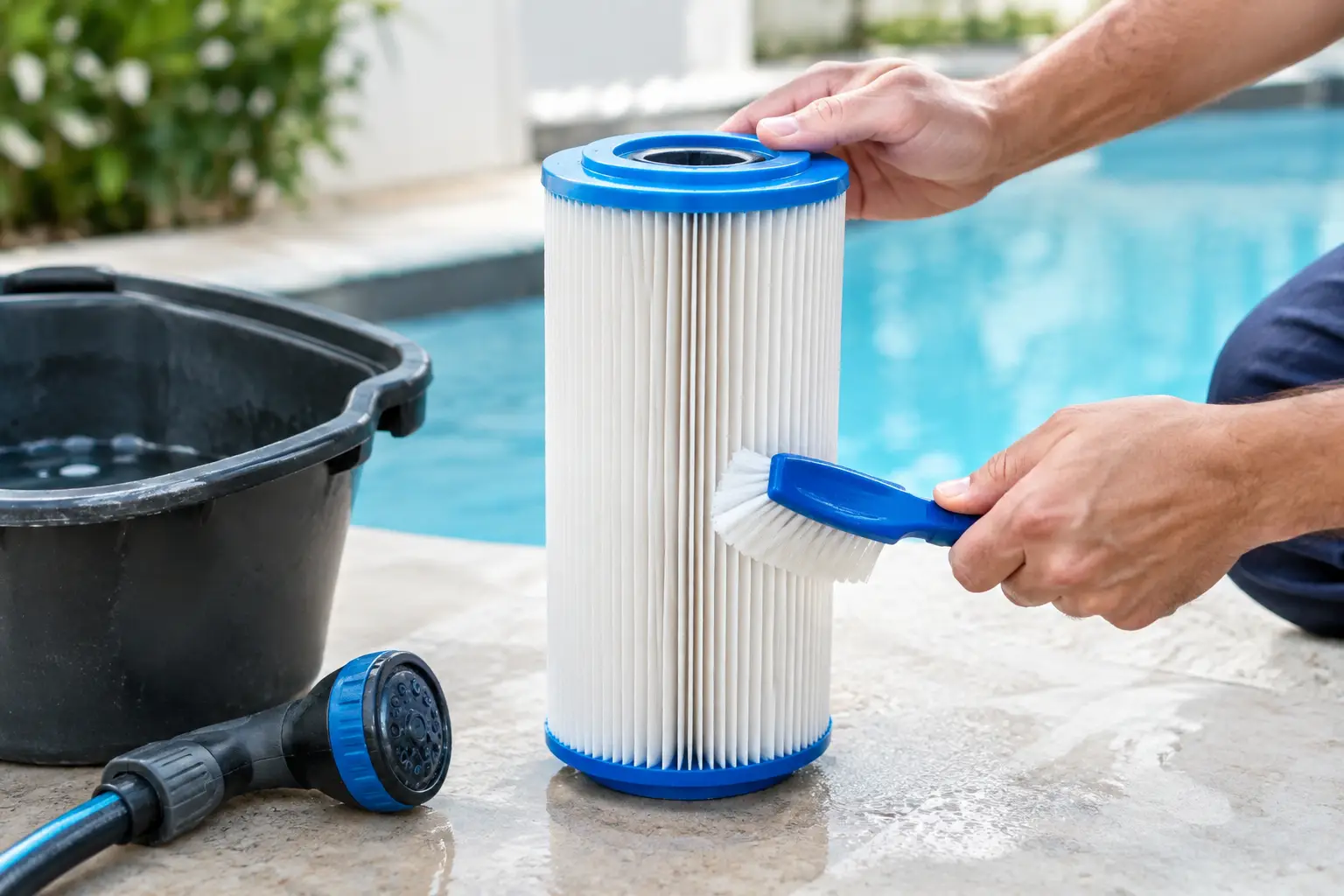
How to Clean Pool Cartridge Filters in Northern Virginia
By Jason DeBosky | 30-Year Pool Industry Veteran Published by The Pool Sharks
A cartridge filter can look clean from the outside while quietly restricting circulation, straining pool equipment, and taking the polished appearance out of otherwise beautiful water. Knowing how to clean pool cartridge filters correctly helps protect the filter media, maintain proper water flow, and preserve the performance of the entire pool system.
For homeowners throughout Northern Virginia, filter maintenance can be especially important during pollen season, after summer storms, and during periods of heavy pool use. Pools in wooded communities such as Great Falls, McLean, Vienna, Clifton, Leesburg, and Haymarket can collect an enormous amount of fine debris that eventually becomes trapped inside the filter pleats.
The Pool Sharks helps homeowners across Loudoun, Fairfax, Fauquier, and portions of Prince William County maintain luxury gunite pools without turning pool ownership into another weekly responsibility. Whether you clean your cartridges yourself or rely on professional weekly pool maintenance, the goal is the same: dependable circulation, protected equipment, and clear, inviting water.
When Does a Pool Cartridge Filter Need Cleaning?
The filter-pressure gauge is usually the most reliable guide. After installing clean cartridges or completing a thorough cleaning, record the pool’s normal operating pressure. This becomes the clean-pressure baseline for that particular system.
Many cartridge filters should be cleaned when the pressure rises approximately 8 to 10 PSI above the clean baseline. Always follow the filter manufacturer’s instructions because equipment specifications can vary.
Other signs that a cartridge filter may need cleaning include:
- Reduced water flow from the return jets
- Cloudy water that takes longer than usual to clear
- A pump that sounds strained or works harder than normal
- Rapidly increasing filter pressure
- Weak circulation in certain areas of the pool
- Debris returning through the pool’s return lines
The calendar alone should not determine when a filter is cleaned. A lightly used pool in Aldie or South Riding may require less frequent service than a pool surrounded by mature trees in Great Falls, Oakton, or Clifton. Pools recovering from algae, storm debris, or heavy swimmer use may need attention much sooner.
Why Cleaning a Cartridge Too Often Can Be a Problem
A cartridge does not need to look brand new to work effectively. A lightly conditioned filter can sometimes capture fine particles better than completely bare filter media.
Unnecessary cleaning increases handling and exposes the cartridge to additional wear. Repeated aggressive rinsing can flatten the pleats, loosen the support bands, and weaken the filter material.
Instead of cleaning on an arbitrary schedule, monitor pressure, return flow, water clarity, and overall system performance. Homeowners who prefer not to track these details can include filter care as part of a professionally managed pool maintenance program.
How to Clean Pool Cartridge Filters Safely
Cleaning cartridge filters is manageable for many homeowners, but the system must be shut down, depressurized, opened, cleaned, and reassembled correctly.
Turn Off the Pool Equipment
Shut off the pool pump at the breaker, disconnect, or equipment timer. Never attempt to open a filter while the system is operating.
Open the air-relief valve on top of the filter tank and wait until the pressure gauge reads zero. A pressurized filter tank can be dangerous, so do not loosen the clamp or locking ring until all pressure has been released.
If the pool equipment is installed below water level, close the appropriate valves to prevent water from flowing backward through the system.
Remove the Filter Lid Carefully
Remove the filter clamp, retaining hardware, or locking ring according to the equipment manufacturer’s instructions. Place the lid and hardware on a clean surface where dirt cannot collect on the sealing surfaces.
Inspect the tank O-ring before proceeding. It should be clean, flexible, undamaged, and seated properly. If lubrication is recommended, use only a silicone-based product approved for pool equipment. Petroleum-based lubricants can swell or damage many pool O-rings.
A deteriorated O-ring can allow air or water to escape and may prevent the filter from sealing correctly after reassembly.
Remove and Inspect Every Cartridge
Lift each cartridge out carefully and keep it upright when possible. Avoid dragging it across concrete or forcing it around the internal plumbing.
Inspect the:
- Pleated filter material
- End caps
- Center core
- Support bands
- Rubber seals
- Cartridge connections
A cartridge with torn pleats, cracked end caps, loose bands, a collapsed center core, or brittle material should be replaced. Damage can allow fine debris to bypass the filter and return to the pool.
If a damaged cartridge is repeatedly causing cloudy water, a professional pool equipment inspection can determine whether the filter itself is the only issue or whether circulation, chemistry, or equipment sizing is also contributing to the problem.
Rinse Cartridge Filters from Top to Bottom
Use a standard garden hose with a gentle spray nozzle. Begin at the top and work downward, directing the water between the pleats at a slight angle.
Rotate the cartridge slowly and rinse every section. Spend additional time around the lower portion because compacted dirt frequently collects near the bottom of the pleats.
Continue rinsing until the runoff is clear and the cartridge is free of visible leaves, insects, pollen, and loose sediment.
Never Use a Pressure Washer
A pressure washer may make a cartridge look clean quickly, but it can permanently damage the filter media. Excessive pressure can:
- Tear the filter fabric
- Flatten or separate the pleats
- Damage the support bands
- Weaken the end-cap adhesive
- Reduce the cartridge’s filtration ability
- Shorten its useful lifespan
A garden hose, patience, and the correct spray angle are safer than aggressive water pressure.
When Should a Cartridge Filter Be Soaked?
Water alone cannot remove every type of contamination. Sunscreen, body oils, cosmetics, and airborne pollutants can leave a greasy coating inside the pleats. Calcium and other minerals can also harden within the filter media, particularly when pool chemistry is not properly managed.
If the cartridge remains slick, gray, or visibly coated after rinsing, use a cleaning product specifically approved for pool cartridge filters. Follow the manufacturer’s dilution, handling, and soaking instructions.
Organic residue and oils should generally be removed before using an acid-based treatment. Applying acid while oils remain in the media can set that contamination more deeply into the cartridge.
Acid washing should not become routine maintenance. It may remove mineral scale, but repeated use can weaken the filter fabric. Persistent scale may indicate a larger water-balance problem that should be addressed through professional pool equipment repair and maintenance.
Never use household laundry detergent, dishwasher products, household degreasers, or unspecified cleaning chemicals. These products can damage the filter media, leave unwanted residue, create foam, and interfere with pool chemistry.
How to Reinstall Pool Cartridges Correctly
After using any filter-cleaning solution, rinse each cartridge thoroughly. Chemical residue left inside the pleats may affect water chemistry or create foam once the circulation system restarts.
Allow the cartridges to drain briefly before returning them to the tank in the proper position and orientation.
Before replacing the lid:
- Confirm that every cartridge is seated correctly.
- Clean the filter tank’s sealing surfaces.
- Inspect and properly position the tank O-ring.
- Replace the lid without forcing it.
- Secure the clamp or locking ring according to the manufacturer’s instructions.
Open the air-relief valve before restarting the pump. Allow the trapped air to escape until a steady stream of water appears, then close the valve.
Inspect the filter lid, clamp, air-relief assembly, drain plug, and nearby fittings for leaks. Record the new clean-pressure reading so you can compare it with future operating pressure.
Common Cartridge-Filter Cleaning Mistakes
Cartridge filters are durable, but their pleated media is more delicate than it appears. Common mistakes include:
- Opening a pressurized filter
- Using a pressure washer
- Spraying too aggressively
- Using unapproved cleaning chemicals
- Acid washing unnecessarily
- Cleaning only one cartridge in a multi-cartridge system
- Reinstalling torn or damaged elements
- Ignoring the filter-tank O-ring
- Reassembling the clamp incorrectly
- Restarting the system without releasing trapped air
If a filter contains several cartridges, clean and inspect every element. Each cartridge contributes to the system’s total filtration area. Leaving one heavily loaded element in place can restrict water flow and undermine the benefit of cleaning the others.
How Long Do Pool Filter Cartridges Last?
Many quality residential cartridges last approximately one to three years, but actual service life varies based on:
- Pool size
- Filter size
- Swimmer load
- Landscaping and debris exposure
- Water balance
- Algae problems
- Cleaning methods
- Pump speed and circulation
- Length of the swimming season
A correctly sized filter serving a properly maintained pool will usually last longer than one continually compensating for algae, poor water chemistry, or an undersized circulation system.
Cartridge replacement may be necessary when pressure rises shortly after cleaning, flow remains weak, the pleats stay compressed, or the material becomes brittle. Fine debris returning to the pool can also indicate that the cartridges are damaged or no longer filtering effectively.
If poor circulation continues with clean cartridges, the problem may involve the pump, valves, plumbing, or filter sizing. Professional pool pump service can identify whether the pump is producing the correct flow for the filter and plumbing system.
Northern Virginia Conditions That Affect Pool Filters
Pool filters in Northern Virginia encounter changing conditions throughout the season. Spring pollen can coat cartridges with fine yellow or green material. Summer storms can wash soil, leaves, mulch, and landscaping debris into the pool. Heavy swimmer use adds sunscreen, body oils, and organic contamination.
Pools in Ashburn, Leesburg, Sterling, Brambleton, and Purcellville may experience different debris conditions than wooded properties in McLean, Great Falls, Vienna, Reston, and Fairfax. Properties in Gainesville, Haymarket, Warrenton, Marshall, and The Plains may also encounter windblown dust, agricultural debris, and heavier organic material.
These local conditions are why pressure and water flow are more dependable than a generic cleaning schedule.
Professional care is particularly valuable during seasonal pool opening, after major storms, and following an algae problem. Cleaning the cartridges without addressing the cause of contamination may only provide temporary improvement.
When Professional Filter Care Is the Smarter Choice
A dirty cartridge is not the only cause of abnormal filter pressure.
Persistent high pressure may be connected to:
- A heavily loaded or damaged cartridge
- A partially closed return valve
- Restricted return plumbing
- Mineral accumulation
- An undersized filter
- Incorrect equipment configuration
Unusually low pressure may indicate:
- A clogged pump basket
- A blocked skimmer
- A suction-side obstruction
- An air leak
- Low pool-water level
- A damaged pump component
A professional should inspect the system when filter pressure remains abnormal after cleaning, cartridges load unusually quickly, water clarity repeatedly declines, or return flow stays weak.
The Pool Sharks evaluates the filter, pump, valves, plumbing, seals, pressure gauge, and water chemistry as one connected system. This helps uncover the cause rather than repeatedly treating the symptom.
Frequently Asked Questions About Cartridge Filters
How often should pool cartridge filters be cleaned?
Clean the cartridges based on filter pressure, water flow, and pool conditions rather than the calendar alone. Many filters need attention when pressure reaches approximately 8 to 10 PSI above the clean baseline.
Can I use a pressure washer on pool cartridges?
No. High-pressure water can tear the filter material, flatten the pleats, damage the end caps, and shorten the cartridges’ useful life.
Can cartridge filters be cleaned with household soap?
Household cleaners are not recommended. They may leave residue, cause foaming, affect water chemistry, or damage the filter media. Use only products specifically approved for pool cartridges.
Why does my filter pressure rise again after cleaning?
Rapidly rising pressure may indicate worn cartridges, algae, incorrect water chemistry, restricted plumbing, or an undersized filter. The entire system may need to be evaluated.
Why is my pool cloudy with clean cartridges?
Cloudy water can result from chemistry problems, insufficient circulation, algae, damaged cartridges, or debris bypassing the filter. A professional pool inspection can help identify the actual cause.
Choose The Pool Sharks for Professional Pool Care
A properly cleaned cartridge should do more than lower the pressure-gauge reading. It should restore strong, quiet circulation and help the water maintain the clear, inviting appearance that a luxury backyard deserves.
The Pool Sharks provides concierge pool care for luxury gunite pools throughout Northern Virginia, including Loudoun County, Fairfax County, Fauquier County, and select communities in Prince William County.
We proudly serve homeowners in McLean, Great Falls, Vienna, Reston, Herndon, Oakton, Fairfax, Clifton, Chantilly, Centreville, Ashburn, Leesburg, Sterling, Brambleton, Aldie, South Riding, Purcellville, Gainesville, Haymarket, Warrenton, Marshall, The Plains, and surrounding Northern Virginia communities.
When filter cleaning becomes repeated high pressure, weak circulation, or disappointing water clarity, let The Pool Sharks inspect the entire system and handle the details before they interrupt your time at home.
The Pool Sharks — Where Luxury Meets Peace of Mind.
Related Pool Care Articles
- Weekly Pool Maintenance in Northern Virginia
- Pool Equipment Repairs and Maintenance
- Professional Pool Opening Services
- Swimming Pool Equipment Inspections
- Pool Pump Repair and Replacement
Continue Exploring Pool Care
Continue with pool equipment repair and diagnostics, 9 Clear Signs Your Pool Filter Needs Repair, Pool Equipment Repair Guide for Better Care, Northern Virginia service areas, and request private client access. These resources help Northern Virginia homeowners connect practical guidance with the appropriate professional service.