9 Signs Your Pool Filter Needs Repair: A Northern Virginia Pool Owner's Guide
By Ashton DeBosky | Owner, The Pool Sharks Published by The Pool Sharks
Meta Description: Is your pool filter failing? The Pool Sharks provides expert pool filter repair across Northern Virginia to keep your water crystal clear and equipment running right.
A swimming pool can look beautiful from the patio while its filtration system is quietly underperforming beneath the surface. By the time the water turns noticeably cloudy or debris begins collecting in corners, the problem may already be placing unnecessary strain on the pump, heater, and overall water chemistry.
Knowing the signs your pool filter needs repair can help you address a developing problem before it interrupts the comfort, appearance, and reliability of your backyard.
For pool owners throughout Northern Virginia, including Leesburg, Ashburn, Great Falls, McLean, Vienna, Middleburg, Aldie, Brambleton, Reston, Haymarket, Gainesville, and surrounding communities, filtration performance can be especially important during our heavy pollen seasons, summer storms, high temperatures, and periods of frequent pool use.
At The Pool Sharks, we look at filtration as part of the entire pool system—not simply as a tank sitting next to the pump.
Your filter plays a central role in circulation, water clarity, equipment protection, and the overall condition of your pool. Whether you have a cartridge, sand, or diatomaceous earth (DE) filter, changes in pressure, circulation, or water quality deserve attention.
1. Your Pool Filter Pressure Is Consistently Too High
A pressure gauge reading significantly above the filter's normal operating pressure is one of the most common signs of restricted water flow.
In many cases, the filter simply needs proper cleaning. However, if the pressure climbs again shortly after cleaning or service, there may be a larger problem.
Possible causes include:
- Clogged or damaged filter cartridges
- Compacted or deteriorated DE grids
- Hardened or contaminated sand
- Restricted plumbing
- Blocked return lines
- Malfunctioning valves
- Internal filter damage
Operating continuously under excessive pressure can also make your pool pump work harder than necessary.
That matters because your filter and pump operate as one circulation system. A filtration problem that is ignored long enough can eventually contribute to problems elsewhere in the equipment pad.
Every pool also has its own normal clean-filter pressure baseline.
One advantage of professional weekly pool maintenance is having someone familiar with your equipment who can recognize when today's pressure reading is significantly different from what is normal for your particular pool.
2. Water Flow From Your Pool Returns Feels Weak
Stand near one of your pool's return fittings and pay attention to the movement of the water.
A properly operating circulation system should produce consistent flow from the returns. If that flow suddenly feels weak, uneven, or noticeably different from normal, something may be restricting circulation.
The cause could be relatively simple, such as:
- A clogged skimmer basket
- A full pump basket
- A dirty filter
But weak circulation can also indicate:
- A damaged filter element
- Suction-side air entering the system
- Pump performance problems
- Valve problems
- Plumbing restrictions
This is why diagnosing a filtration problem should involve evaluating the entire circulation system, rather than simply opening the filter and assuming it is dirty.
Weak circulation creates additional problems throughout the pool.
Sanitizer does not distribute as effectively. Fine particles remain suspended longer. Dead spots can develop where water movement is limited. Those conditions can make it easier for algae and debris to gain a foothold.
For Northern Virginia homeowners who expect their pool to remain ready for family, entertaining, or an unexpected weekend gathering, inconsistent circulation is worth addressing early.
If the problem appears to involve the pump rather than the filter, professional pool pump replacement and equipment evaluation can help determine the actual source before unnecessary equipment is replaced.
3. Your Pool Water Remains Cloudy After Normal Treatment
Cloudy pool water is frequently blamed entirely on chemistry.
But chemistry is only part of the equation.
A pool can have appropriate sanitizer levels and still appear dull, hazy, gray, or slightly milky when the filtration system cannot effectively remove suspended particles from the water.
This is particularly common in Northern Virginia following:
- Heavy thunderstorms
- High pollen periods
- Landscaping work
- Large pool gatherings
- Wind events
- Spring opening
- Heavy organic debris
A properly functioning filtration system should gradually recover from these conditions when circulation, chemistry, and filtration are properly managed.
If cloudy water repeatedly returns despite appropriate treatment, the filter media or internal components may be worn, damaged, improperly installed, or simply incapable of handling the current demand.
Adding more chemicals is not automatically the solution.
Excessive chemical adjustments can complicate water balance while doing nothing to correct an underlying mechanical filtration problem.
A professional evaluation can determine whether the pool needs a thorough filter cleaning, new filter media, internal repairs, or a broader circulation-system inspection.
4. Sand, DE Powder, or Debris Is Returning to the Pool
Your filtration system is designed to remove material from the water—not send it back into the pool.
If you begin noticing sand beneath the return fittings, DE powder collecting on the pool floor, cartridge fibers, or unusual amounts of fine debris returning through the circulation system, the filter deserves prompt attention.
Sand Filter Problems
Sand appearing inside the swimming pool can indicate a damaged lateral or standpipe inside the filter.
DE Filter Problems
DE powder returning to the pool may indicate:
- Torn grids
- Damaged grid fabric
- A cracked manifold
- Improperly seated internal components
- Failed seals
Cartridge Filter Problems
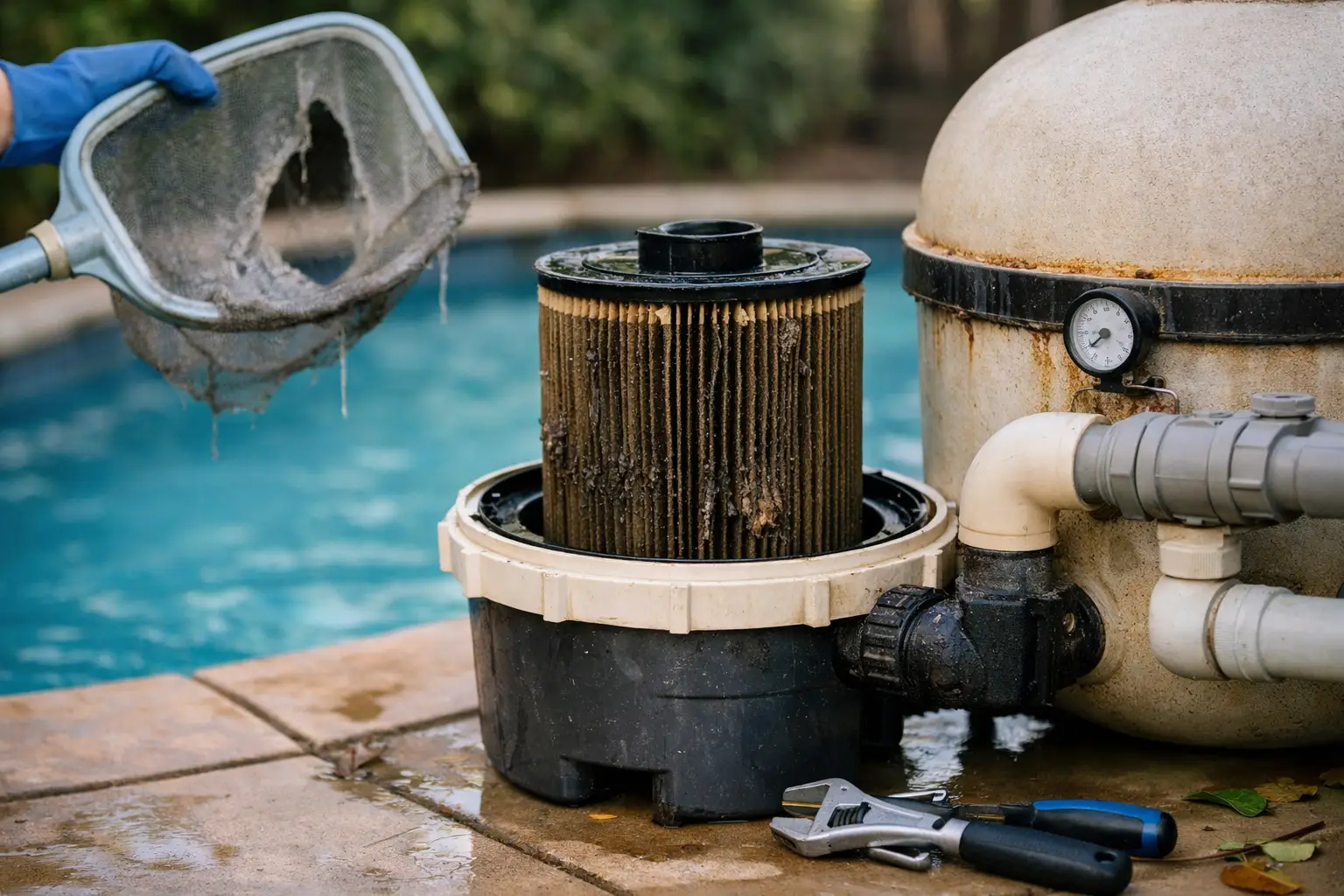
Cartridge systems can allow debris to bypass filtration when cartridges become:
- Cracked
- Torn
- Collapsed
- Improperly seated
- Severely deteriorated
This is one of the stronger indicators that you're dealing with something beyond routine filter maintenance.
Continuing to operate damaged filtration components can reduce water quality and potentially worsen the underlying problem.
5. You Notice Water Leaking Around the Filter
Water around your pool equipment should never automatically be considered normal.
A small drip can become a significant leak when the filtration system is operating under pressure.
Common leak locations include:
- Tank clamps
- Pressure gauges
- Air-relief assemblies
- Drain plugs
- Plumbing connections
- Unions
- Multiport valves
- Tank seals
Some leaks are relatively straightforward and may require nothing more than a new O-ring, gasket, gauge, or fitting.
Others can indicate something considerably more serious.
A Cracked Filter Tank Requires Immediate Attention
A cracked filter tank should be treated differently from an ordinary plumbing drip.
Pool filters operate as pressurized vessels. A compromised tank should be evaluated before continuing normal operation.
Northern Virginia's seasonal temperature swings also matter. Equipment that was not properly protected during winter can suffer freeze-related damage that becomes apparent when the system is restarted in spring.
Professional pool opening service provides an opportunity to identify these problems before the equipment enters another full swimming season.
6. Your Pump Loses Prime or Air Appears in the System
Air bubbles coming from the pool returns, a pump basket that refuses to remain completely filled with water, or repeated loss of prime can indicate a circulation problem affecting filtration performance.
Possible causes include:
- Worn pump-lid O-rings
- Loose unions
- Valve seal problems
- Suction-side plumbing leaks
- Improperly reassembled equipment
- Low pool water level
- Restricted skimmer flow
The filter itself may not necessarily be causing the air leak, but filtration performance suffers when air enters the circulation system.
Air can reduce circulation efficiency, interfere with consistent pressure readings, and force the pump to work harder.
If the problem begins immediately after filter cleaning or equipment service, it may also indicate that something was not properly resealed or reassembled.
This is where systematic troubleshooting becomes far more valuable than trial and error.
7. Your Pool Filter Needs Cleaning Much More Often Than It Used To
Every swimming pool filter requires routine maintenance.
What isn't normal is a filter suddenly requiring constant attention.
Examples include:
- Cartridge filters clogging unusually quickly
- Sand filters requiring frequent backwashing
- DE filters rapidly climbing in pressure
- Circulation declining shortly after cleaning
Sometimes there is nothing mechanically wrong with the filter.
The pool may simply be experiencing an unusually high debris load caused by construction, mature trees, heavy pollen, landscaping, storms, or frequent entertaining.
However, when frequent cleaning becomes the new normal, it is worth evaluating the filtration system as a whole.
The filter may be undersized, its media may be deteriorating, or another circulation problem may be contributing to the rapid pressure increase.
Over-cleaning can also be counterproductive.
For example, unnecessary backwashing wastes water and can interfere with normal filter operation. The objective isn't to clean a filter as frequently as possible.
The objective is to keep it operating efficiently.
8. Your Pool Equipment Develops New or Unusual Noises
The filter itself should generally operate quietly.
New sounds such as:
- Hissing
- Gurgling
- Whistling
- Vibrating
- Pressure-related noises
deserve investigation, particularly when they occur alongside leaking water, weak circulation, air bubbles, or abnormal pressure readings.
The noise could originate from air moving through the circulation system, a restriction, a valve problem, or pressure escaping through a compromised seal.
Pool equipment combines water, electricity, moving equipment, and pressurized components.
Unusual equipment noises are something to diagnose—not something to simply wait out.
9. Your Pool Is Becoming Harder to Keep Crystal Clear
Sometimes the earliest warning isn't located at the equipment pad.
It's visible in the pool itself.
As filtration performance declines, you may notice:
- Increased sanitizer demand
- Debris returning shortly after vacuuming
- Water losing its sparkle between visits
- Dirt accumulating faster than normal
- Increased algae pressure
- Walls or steps feeling less clean
- Repeated cloudy-water conditions
None of these symptoms automatically means your filter is damaged.
But when several occur alongside changing pressure or reduced circulation, they become valuable diagnostic clues.
A luxury pool should not require constant correction just to remain inviting.
Consistently beautiful water comes from the relationship between proper chemistry, dependable circulation, effective filtration, and attentive maintenance.
When one of those components begins to fail, the entire pool becomes more difficult to manage.
Pool Filter Cleaning vs. Repair vs. Replacement
One of the biggest mistakes pool owners can make is assuming every filtration problem requires a new filter.
It doesn't.
Many filtration issues can be corrected through proper service.
Your Filter May Simply Need Cleaning
Routine buildup may be corrected through professional filter cleaning and inspection.
Learn more about our pool filter cleaning service.
Your Filter May Need New Media or Internal Components
Depending on the system, that could include:
- Replacement cartridges
- DE grids
- Manifolds
- Laterals
- O-rings
- Valve components
- New sand or alternative filter media
Your Filter May Need Replacement
Replacement becomes more appropriate when the tank is compromised, internal components have significantly deteriorated, repair costs no longer make sense, or an older system is poorly matched to the pool.
The correct recommendation depends on more than the age printed on an equipment label.
It should consider:
- Pool volume
- Plumbing configuration
- Pump performance
- Filter size
- Equipment condition
- Debris load
- Landscaping
- How frequently the pool is used
- How the homeowner expects the pool to perform
At The Pool Sharks, our objective isn't to replace equipment simply because something isn't working perfectly.
Our objective is to identify why it isn't performing properly and recommend the most sensible path toward restoring dependable operation.
Why Northern Virginia Pools Place Unique Demands on Filtration
Pool filtration in Northern Virginia presents challenges that homeowners in some other parts of the country don't experience to the same degree.
Our pools move through dramatically different seasonal conditions.
Spring can bring enormous pollen loads.
Summer brings heat, thunderstorms, heavy pool usage, and rapidly changing water conditions.
Fall introduces leaves and organic debris.
Winter introduces freezing conditions that can damage improperly winterized equipment.
Pools in heavily landscaped communities such as Great Falls, McLean, Vienna, Middleburg, Leesburg, Ashburn, Aldie, Clifton, Haymarket, and Warrenton can experience particularly significant organic debris loads.
That makes proper filtration, circulation, and seasonal care especially important.
Professional pool closing service is also critical for protecting filtration equipment from freeze damage during the Northern Virginia winter.
The Pool Sharks Approach to Pool Filtration
At The Pool Sharks, we believe the equipment behind your pool should receive the same level of attention as the water you see from the patio.
Our approach is based on concierge-style pool stewardship.
That means looking beyond whether today's water happens to be clear.
We look at the relationship between:
- Water chemistry
- Circulation
- Filtration
- Pumps
- Heaters
- Sanitizing systems
- Automation
- Seasonal conditions
- Overall equipment performance
Catching a developing filter problem early can prevent a relatively minor maintenance issue from becoming an inconvenient equipment failure during the middle of swimming season.
For homeowners throughout Loudoun County, Fairfax County, Fauquier County, and Prince William County, dependable pool care is ultimately about something bigger than clean water.
It's about having confidence that your pool will be ready when you want to use it.
That's The Pool Sharks — Where Luxury Meets Peace of Mind.
Need Help With a Pool Filter Problem in Northern Virginia?
If your filter pressure is climbing, circulation feels weak, water remains cloudy, or something simply doesn't seem right at the equipment pad, don't wait until the system stops working completely.
The Pool Sharks provides professional pool equipment evaluation, filtration service, maintenance, and repair throughout Northern Virginia.
We can determine whether your system needs cleaning, repair, replacement components, or a broader equipment diagnosis—and help you make the right decision without replacing equipment unnecessarily.
Explore our pool equipment repair services or learn how our weekly pool maintenance helps identify developing equipment problems before they interfere with your swimming season.
The Pool Sharks Where Luxury Meets Peace of Mind.
Related Pool Care Articles
Continue learning how to protect your pool, water quality, and equipment:
- What Is Included in Weekly Pool Maintenance?
- Why Is My Pool Water Cloudy?
- Pool Pump Replacement and Circulation Problems
- Professional Pool Filter Cleaning
- Pool Equipment Repairs and Troubleshooting
- Professional Pool Opening Service
- Professional Pool Closing Service
Continue Exploring Pool Care
Continue with pool equipment repair and diagnostics, Pool Equipment Repair Guide for Better Care, Pool Pump Reviews for Luxury Homeowners, Northern Virginia service areas, and request private client access. These resources help Northern Virginia homeowners connect practical guidance with the appropriate professional service.